
Blog
Unlock Cognitive Growth: Advantages of Abacus for Kids
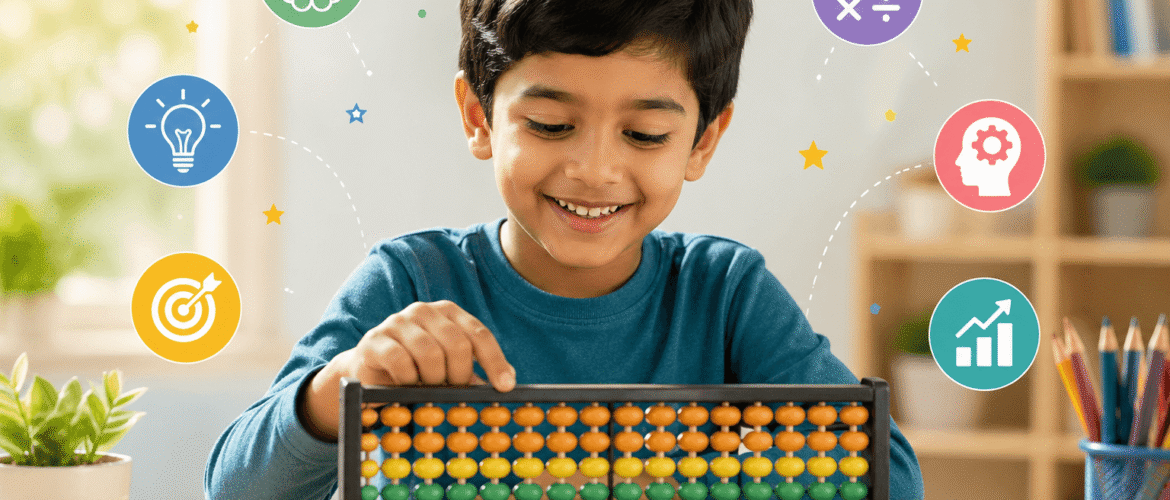
In an era heavily dominated by smartphones, tablets, and instant digital answers, parents and educators are constantly searching for ways to keep young minds sharp, focused, and actively engaged. While technological advancements have undoubtedly revolutionized education, there is a growing movement returning to one of the world’s oldest and most effective mathematical instruments. When evaluating extracurricular activities and foundational learning methods, the sheer number of advantages of abacus for kids becomes impossible to ignore.
Far from being an outdated relic, the abacus is a dynamic, highly effective brain-training instrument. It is not just about crunching numbers; it is about holistic cognitive development, fostering an environment where a child’s brain is stimulated on multiple levels. If you have ever wondered whether enrolling your child in a mental math program is worth the investment of time and resources, understanding the profound advantages of abacus for kids will illuminate why this ancient tool is making a massive comeback in modern education.
What is an Abacus? A Timeless Educational Instrument
Before diving into the benefits, it is essential to understand what this tool is and why it has survived for millennia. Originating thousands of years ago, the abacus was the primary calculator for ancient merchants and scholars across Asia, Europe, and the Middle East. Today, it has been refined into a highly sophisticated abacus educational tool used globally to teach children the fundamentals of numbers and arithmetic.
Among the various types of abacuses, the Japanese Soroban—which features one bead in the upper deck and four in the lower deck—is the most popular in modern education. The soroban method for early childhood education is celebrated for its base-10 system, which perfectly aligns with modern mathematics. It teaches children to represent numbers visually, turning abstract mathematical concepts into tangible, physical realities that they can touch and move.
Holistic Brain Development: The Cognitive Benefits
When parents ask about the primary benefits of this tool, the conversation must start with the brain. The cognitive benefits of mental arithmetic acquired through regular abacus practice are scientifically backed and astonishingly broad.
Understanding Brain Lateralization
The human brain is divided into two hemispheres. Generally, the left hemisphere is responsible for logical processing, language, and mathematical operations. The right hemisphere manages creativity, visualization, intuition, and spatial awareness.
If you are wondering, why is mental math important for brain lateralization? The answer lies in how an abacus forces the brain to communicate across both hemispheres. When a child performs math the traditional way (using a pen and paper), they predominantly use their left brain. However, when they use an abacus, they physically move beads using their fingers (stimulating the right brain’s spatial and motor centers) while processing mathematical rules (left brain). Eventually, as they transition to mental math, they visualize the abacus in their mind’s eye, bridging the gap between logic and imagination. This whole-brain development leads to higher overall intelligence and enhanced problem-solving skills.
Harnessing Neuroplasticity
The brains of young children are highly malleable, a concept known as neuroplasticity. Neuroplasticity and tactile learning in young children go hand-in-hand. By physically touching and moving the beads, children create strong neural pathways. The tactile feedback of the beads snapping against the frame reinforces learning in a way that staring at a screen or a worksheet simply cannot. This physical interaction solidifies the neural connections related to numbers, making future complex mathematics feel intuitive rather than intimidating.
Enhancing Focus, Concentration, and Memory
In a world filled with constant digital distractions, one of the greatest gifts you can give a child is the ability to focus deeply on a single task.
Laser-Like Concentration
Improving concentration through beads calculation is one of the most immediate and noticeable benefits parents report. To solve an equation on an abacus, a child must pay absolute attention to the numbers being called out, remember the sequence, apply the correct formula, and move the exact beads. A single lapse in concentration means the final answer will be wrong. Over time, children develop the ability to block out external noise and distractions, channeling their entire mental capacity into the task at hand. This improved focus naturally spills over into their regular schoolwork, reading, and listening skills.
Memory Expansion
A common question from parents is: how does abacus training improve memory? The process happens in stages. Initially, the child memorizes the formulas and the physical layout of the board. As they advance, the physical abacus is taken away, and they are asked to perform the calculations mentally. They must hold the image of the abacus in their working memory and manipulate the imaginary beads to arrive at the answer.
This leads directly to developing photographic memory using mental imagery. Because the child is trained to visualize the beads instantly, they begin to apply this visualization technique to other areas of their life. They can recall words, images, and concepts with greater ease because their brain has been trained to “take a picture” of the information and store it visually.
Physical and Motor Skill Development
While the cognitive leaps are impressive, the physical benefits of the abacus should not be overlooked.
Fine Motor Skills
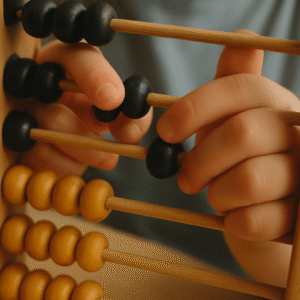
Using an abacus requires children to use their thumb, index, and sometimes middle fingers in rapid, precise movements. This leads to profound fine motor skill enhancement through bead manipulation. The dexterity required to flick a specific bead up or down without disturbing the adjacent beads strengthens the small muscles in the hands and fingers.
This enhancement of fine motor skills is particularly beneficial for younger children who are still learning to grip a pencil properly, write legibly, or perform everyday tasks like tying shoelaces or buttoning a shirt. The repetitive, deliberate movements act as a physical therapy of sorts, refining their hand-eye coordination to a highly advanced level.
Transforming Math Performance and Attitude
Mathematics is a subject that notoriously causes stress and anxiety among young students. The abacus turns this narrative completely upside down.
Speed, Accuracy, and Efficiency
As children progress through an abacus curriculum, their ability to calculate numbers skyrockets. Boosting speed and accuracy in basic operations—addition, subtraction, multiplication, and division—becomes second nature. An advanced abacus student can often solve multi-digit arithmetic problems faster than an adult can type the numbers into a calculator.
This speed is not just a party trick; it is an incredible academic advantage. When a student transitions into higher grades, complex subjects like algebra, geometry, and physics require a tremendous amount of basic arithmetic. Because the abacus student calculates these basic operations instantly and accurately, their cognitive load is freed up to focus on the complex logic of the advanced math problem. Furthermore, mastering Japanese soroban techniques for competitive exams gives students a massive edge, allowing them to complete timed tests with minutes to spare and an incredibly low margin of error.
Conquering Math Anxiety
Math anxiety is a very real psychological phenomenon where a child feels a sense of panic, tension, or fear when confronted with numbers. The abacus acts as a powerful antidote. Overcoming math anxiety with visual tools works because it removes the abstract nature of numbers. A “7” is no longer just a squiggly line on a page; it is one upper bead and two lower beads.
By making math visual and tactile, the child sees the logic unfold right in front of them. It makes sense to their brain. Because of this, the abacus is highly effective at building confidence in arithmetic for slow learners. A child who may have previously struggled to grasp the concept of borrowing or carrying over in addition and subtraction suddenly “gets it” because they can physically see the beads moving across the rods. As they begin to get the right answers consistently, their confidence blooms, turning a subject they once dreaded into one they actively enjoy.

Abacus vs. Other Mental Math Methods
When exploring math enrichment programs, parents frequently encounter different methodologies and naturally wonder which is best for their child. A common debate in educational circles is abacus vs vedic math for students. Understanding the distinction is crucial for making the right choice for your child’s learning style.
The Abacus Method:
- Best For: Younger children (ages 4 to 12).
- Core Concept: Tactile and visual learning. It relies on a physical tool that eventually transitions into mental visualization.
- Strengths: Develops whole-brain thinking, improves fine motor skills, and fundamentally builds working and photographic memory. It requires no prior mathematical knowledge to start, making it perfect for early childhood education.
- Learning Curve: Requires consistent, daily practice to master muscle memory and visualization.
Vedic Mathematics:
- Best For: Older children and teenagers (ages 11 and up).
- Core Concept: A collection of ancient Indian sutras (rules/formulas) that provide shortcuts for complex calculations.
- Strengths: Excellent for bypassing tedious calculations in algebra, advanced multiplication, and roots. It is highly logic-driven and rule-based.
- Learning Curve: Requires the student to already possess a solid foundation in basic arithmetic and multiplication tables.
The Verdict: While Vedic math provides excellent “tricks” and shortcuts for older students tackling complex exams, the abacus is foundational. It actually alters the cognitive structure of a young child’s brain, teaching them how to process information rather than just giving them a shortcut to an answer. For long-term brain development, memory enhancement, and establishing an unbreakable foundation in numeracy, the abacus is universally recommended for early childhood.
Identifying the Ideal Starting Point
With all these benefits, parents are eager to enroll their children, leading to the inevitable question: what is the best age for kids to start abacus classes?
Child development psychologists and educators generally agree that the optimal window is between the ages of 4 and 7.
Why this specific window?
- Peak Neuroplasticity: During these early years, a child’s brain is growing and forming neural connections at a rapid rate. They absorb new information like a sponge.
- Number Concept Formation: At this age, children are just beginning to understand what numbers mean. Introducing the abacus allows them to form a visual and spatial understanding of numbers from the very beginning, preventing bad math habits from forming.
- Motor Skill Readiness: By age 4 or 5, children have developed enough baseline motor control to manipulate the beads, but practicing on the abacus will push their dexterity to the next level.
While 4 to 7 is the ideal age, older children (8 to 12) can still glean massive benefits. Their progress through the initial physical stages is often faster, though transitioning to mental visualization might take slightly more effort than it does for a younger child whose brain is highly accustomed to imaginative play.
Actionable Guide: Bringing the Abacus into Your Child’s Routine
You do not necessarily need to live near a specialized academy to reap these benefits. Starting abacus learning at home for beginners is entirely feasible with the wealth of online resources, apps, and guidebooks available today. Here is a step-by-step guide to successfully integrating this tool into your child’s educational routine.
Step 1: Choose the Right Tool
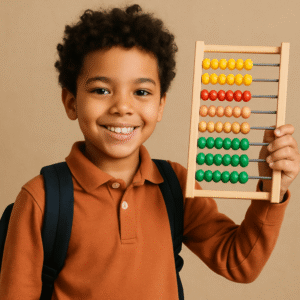
When purchasing an abacus for children, specifically look for a 13-rod or 17-rod Japanese Soroban. Ensure the beads are appropriately sized for your child’s fingers. Avoid the colorful “toy” abacuses (often featuring 10 large beads per row on a wire frame) commonly found in preschools. While those are great for basic counting, they cannot be used to teach the advanced formulas and mental visualization techniques of the soroban method. Look for an educational-grade tool with a sturdy frame and smooth-gliding beads.
Step 2: Establish a Routine
Consistency is far more important than duration. The brain builds neural pathways through repetition. Sitting down for two hours on a Saturday will not yield the same results as practicing for 15 minutes every single day. Make it a part of the daily routine—perhaps right after school, or as a warm-up before regular homework.
Step 3: Learn the Basics Together
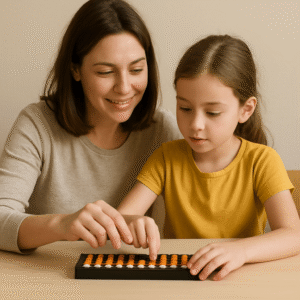
If you are teaching your child at home, you must learn the basics yourself. Start by understanding how to represent numbers 1 through 9.
- Lower beads: Each represents a value of 1. They are moved up to the center beam to be counted.
- Upper bead: Represents a value of 5. It is moved down to the center beam to be counted. Spend the first week just having your child push the beads to represent numbers that you call out. “Show me a 3! Show me an 8!” Make it a fast-paced, exciting game.
Step 4: Master the “Friends” Concepts
The magic of the abacus lies in its complementary numbers, often taught to children as “Big Friends” (numbers that add up to 10, like 9 and 1, 8 and 2) and “Little Friends” (numbers that add up to 5, like 4 and 1, 3 and 2). When a rod runs out of beads, children use these “friends” to carry over to the next rod. Use flashcards and stories to help them memorize these pairs before attempting complex addition.
Step 5: Transition to Mental Math Gradually
Do not rush the mental imagery phase. Allow your child to rely on the physical abacus for several months until their fingers move almost automatically. When they are ready, have them close their eyes and imagine the frame. Ask them to add 1 + 2 in their mind. Prompt them: “Visualize pushing up one bead. Now push up two more. How many beads are touching the center bar?” Celebrate these early mental math victories enthusiastically.
Step 6: Keep it Fun and Positive
If a child feels pressured, their brain’s stress response will block the pathways necessary for learning. Keep practice sessions light. Incorporate gamification by using timers to track their speed, rewarding them when they beat their personal best. Celebrate accuracy over speed in the beginning.
Overcoming Common Challenges During Learning
Like any worthwhile educational endeavor, learning the abacus comes with its hurdles. Being prepared for these challenges will help you guide your child through them smoothly.
The “Plateau” Phase: After an initial period of rapid improvement, many children hit a plateau where the formulas become more complex, and their speed drops. This is completely normal. During this time, reduce the difficulty of the problems and focus heavily on accurate finger movements. Rebuild their confidence with easier equations before tackling the harder ones again.
School Curriculum Conflict: Sometimes, children get confused because the method of addition taught in their standard school curriculum (like vertical stacking and writing a “1” to carry over) differs from the abacus method. Remind your child that math is like a destination, and there are many different roads to get there. Encourage them to use the abacus method as a way to double-check the answers they get using their school’s required method. Eventually, their mental math will become so fast that they will internally use the abacus to solve the school problems instantly.
The Broader Impact: Real-World Success
To truly understand the value of this tool, one must look at how it impacts a child’s everyday life outside the context of a math worksheet.
Consider a child who struggles with ADHD or general distractibility. Traditional tutoring might force them to sit still and stare at a book, leading to frustration. The abacus, however, gives their restless hands a productive task. The click-clack of the beads provides satisfying sensory feedback. Over months of practice, parents of hyperactive children frequently report a noticeable lengthening of their child’s attention span. They can sit through dinner, complete puzzles, and follow multi-step instructions much more effectively.
Furthermore, consider the immense confidence boost. Imagine a 7-year-old child at a grocery store keeping a running mental tally of the items placed in the cart, instantly calculating the change required before the cashier even hits the total button. The pride and self-assurance that stem from mastering such a complex cognitive skill permeate every aspect of their personality. They become more willing to raise their hand in class, take on leadership roles in group projects, and approach new, difficult subjects with a “can-do” attitude.
Frequently Asked Questions (FAQs)
To provide a comprehensive overview, let’s address some of the most common questions parents and educators have regarding abacus training.
1. Will using an abacus confuse my child with their regular school math? No, it actually complements it. While the initial methodology (moving beads vs. writing numbers) is different, the underlying logic of base-10 mathematics is identical. Once the child masters the abacus, they will have a deeper foundational understanding of why school math formulas work, rather than just memorizing steps.
2. How long does it take to see the benefits? Every child is different, but most parents notice a significant improvement in focus and basic calculation speed within the first 3 to 6 months of consistent daily practice (15-20 minutes a day). The transition to high-speed mental visualization usually occurs between 9 to 12 months.
3. Is it too late for my 10-year-old to start? Absolutely not. While the 4-7 age range is ideal for neuroplasticity, older children often grasp the logical rules and “friend” formulas much faster than preschoolers. A 10-year-old can make rapid progress and will heavily benefit from the concentration and memory enhancement as they prepare for the heavier academic loads of middle and high school.
4. Do we need a tutor, or can I teach my child myself? Both approaches are valid. If you are highly dedicated, you can use books and online tutorials for starting abacus learning at home for beginners. However, the formulas can become quite complex at advanced levels. Enrolling your child in a certified program or hiring a specialized tutor ensures they learn the correct finger techniques from day one and receive structured, progressive lesson plans.
5. How is the abacus helpful for children with learning disabilities? Because the abacus is a multi-sensory tool—involving sight, touch, and sometimes sound (the clicking of the beads)—it is highly effective for children who struggle with traditional, purely abstract learning. It is particularly useful in building confidence in arithmetic for slow learners or those with dyscalculia, as it provides a permanent visual anchor for abstract numerical values.
The Lifelong Gift of Mental Agility
In conclusion, the decision to introduce a child to this ancient method is one that yields dividends for a lifetime. When we look closely at the advantages of abacus for kids, it becomes clear that we are not merely teaching them how to add and subtract. We are actively wiring their brains for success.
From the robust cognitive benefits of mental arithmetic and the stimulation of whole-brain lateralization, to the tangible improvements in fine motor skills and focus, the impact is undeniably profound. It is a powerful method for overcoming math anxiety with visual tools, transforming a subject often feared into a playground of logic and speed.
Whether your goal is to give your preschooler a head start, help a struggling student find their confidence, or equip your child with Japanese soroban techniques for competitive exams, the abacus stands out as one of the most effective educational investments you can make. By taking a step back from screens and calculators and returning to the tactile, intentional practice of bead calculation, you are giving your child the ultimate tools for academic excellence, unshakeable confidence, and lifelong mental agility.