
Blog
Abacus vs Calculator: Which Actually Helps Your Child Learn Maths?
Abacus vs Calculator: Which Actually Helps Your Child Learn Maths?
If you’ve ever watched your child reach for a calculator to work out 8 + 5, you’ve probably had this thought: is this helping them, or just letting them skip the part where they actually learn? It’s a fair question, and in a world where every phone has a calculator built in, more parents are asking whether an old-fashioned bead frame is really worth the time and cost compared to a tool that’s already in every home.
The honest answer is that they’re not really doing the same job — one builds a skill, the other replaces the need for it. Here’s the real difference, and where each one actually fits.
The Core Difference: Active vs Passive Calculation
A calculator is designed to remove thinking from the process. You input two numbers, press a button, and the answer appears — the child’s brain does no calculation work at all. That’s exactly what makes it useful for an adult who already knows how numbers work and just wants speed. For a child who’s still building number sense, though, it skips the exact step that builds understanding.
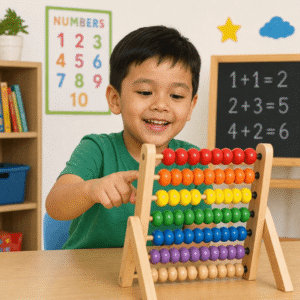
An abacus works the opposite way: the child is the calculator. Every bead moved represents a real quantity, and every calculation requires the child to actively track place value, carrying, and regrouping as they go. Nothing gets outsourced — which is slower at first, but is exactly why it builds real number sense instead of just producing an answer.
What Each One Actually Teaches
| Calculator | Abacus | |
| Produces a correct answer | Yes, instantly | Yes, with practice |
| Builds understanding of place value | No | Yes |
| Builds mental calculation ability | No | Yes, over time |
| Useful for complex/large calculations later | Yes | Limited (not its purpose) |
| Builds working memory & concentration | No | Yes |
| Requires effort or practice to use well | No | Yes |
This is really the whole answer in one table: a calculator is a tool for getting an answer, and an abacus is a tool for becoming someone who’s good at getting answers. They’re not competing for the same job.
Where a Calculator Genuinely Wins
It’s worth being fair here — calculators aren’t the enemy, and there’s no need to ban them at home. They’re the right tool when:
- The numbers are large or complex enough that manual calculation isn’t a good use of time (this becomes relevant from around age 12–13 onward, in subjects like science or advanced maths)
- Your child already has strong number sense and just needs speed for a specific task
- You’re checking homework rather than teaching a concept
The mistake isn’t using a calculator — it’s introducing it before a child has built their own internal sense of how numbers work. Once that foundation exists, a calculator becomes a genuine productivity tool rather than a shortcut around learning.
Where the Abacus Genuinely Wins
The abacus earns its place specifically in the years when number sense is still forming — roughly ages 5 to 10. In that window, it does three things a calculator structurally cannot:
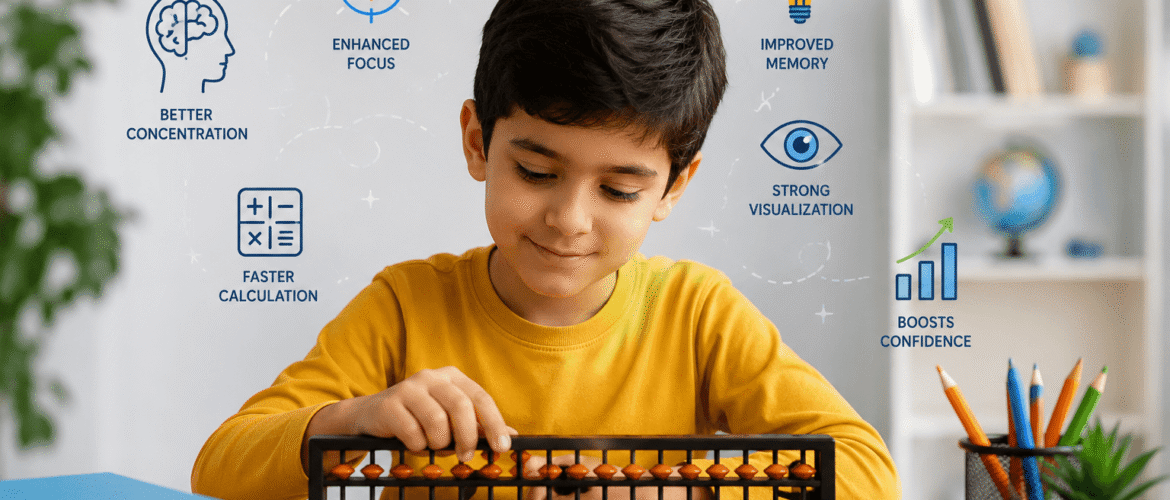
It builds mental calculation ability. With consistent practice, a child moves from using the physical tool to visualizing it — eventually solving multi-digit sums in their head, without any tool at all. A calculator can never produce this outcome, because it was never designed to be removed.
It trains sustained focus. Tracking bead positions while new numbers keep arriving is a genuine working-memory exercise. Pressing calculator buttons requires none of that mental effort.
It builds confidence through visible progress. A child can watch themselves get measurably faster and more accurate week over week — a concrete sense of “I’m getting better at this” that a calculator, which does the same job regardless of the user’s skill, simply can’t offer.
Soroban vs Suanpan: If You’re Choosing an Abacus Type
If you do go the abacus route, you’ll likely come across two traditional designs, and it’s worth knowing the difference before picking a class:
The Chinese Suanpan has two beads on the upper deck and five on the lower deck per rod — an older design that can represent a wider range of number systems, but requires an extra mental step to map onto today’s base-10 maths.
The Japanese Soroban simplified this to one upper bead and four lower beads per rod, which lines up directly with the base-10 system used in modern schooling. This is why most current abacus programs — including mental-math training — are built around the soroban rather than the suanpan: there’s simply less translation between “what the beads show” and “what the child needs to calculate” in everyday maths.
For a child learning maths in a standard school system today, the soroban is almost always the more practical choice.
So Which One Should Your Child Use?
Not an either/or — a sequence. The most effective approach most educators recommend is:
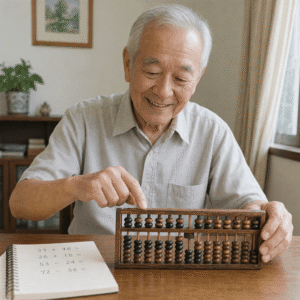
- Ages 5–10: Build real number sense and mental calculation ability through abacus training, while calculators stay out of the picture for basic arithmetic.
- Ages 10+: Once that foundation is solid, introduce the calculator for what it’s actually good at — handling complexity and saving time on large or advanced calculations, not replacing basic maths thinking.
A child who learns this way ends up with both: the internal number sense that makes maths feel intuitive rather than frightening, and the practical fluency with tools they’ll use for the rest of school and life.
Frequently Asked Questions
Should I stop my child from using a calculator altogether?
Not necessarily — just delay it for basic arithmetic until number sense is established, generally after a year or two of consistent abacus practice or equivalent maths foundation work.
Will abacus training make my child slower at using a calculator later?
No — if anything, children with strong mental calculation skills use calculators more effectively later, because they can sanity-check the output instead of blindly trusting it.
Is one better for exams — calculator or abacus skills?
Most school exams for younger children (primary level) don’t allow calculators, which is exactly where abacus-trained mental calculation speed gives a real, direct advantage.
My child already relies heavily on a calculator — is it too late for abacus training?
No. It takes a bit more patience to build the habit of calculating without a tool, but the underlying method works the same at any age within the typical enrolment range.
If you’d rather your child build real number confidence instead of calculator dependency, Foxbrain’s Abacus program is structured around exactly this progression — soroban-based training that takes children from physical bead calculation to genuine mental maths fluency, at their own pace.