
Blog
Effective Ways to Teach Tables to Kids with Fun Games

How to teach tables to kids
Learning multiplication tables becomes easier when children see them as patterns, stories, and games instead of a long list to memorise. This guide explains how to teach tables to kids step by step, with practical teaching strategies, simple educational games, and quick activities that work well at home or in an Indian classroom. The goal is not just fast recall, but confidence, understanding, and regular practice without pressure.
What is the best way to teach tables to kids?
The best way is to move from meaning to memory: first help children understand multiplication as repeated addition, then show patterns, practise in small groups of tables, and finally build speed through games and revision. If a child only chants “six ones are six, six twos are twelve” without understanding, they may forget under pressure. But when they know that 6 × 4 means four groups of six, the table starts making sense.
Use a mix of oral practice, writing, visual aids, and movement. In India, children often learn tables through chanting, which can be useful, but it works better when combined with activities like skip counting on fingers, arranging rajma beans or pencils in groups, and playing quick recall games.
Before you start, make tables feel useful
Children learn faster when they know why a skill matters. Start with daily-life examples they already understand: buying 3 packets of biscuits with 5 biscuits each, counting wheels on 4 cars, or finding the total cost of 6 pencils priced at ₹4 each. These examples make multiplication feel practical instead of abstract.
Keep the first few sessions short. A 7- to 10-minute focused activity every day is usually more effective than one long weekly session. Avoid introducing too many tables at once, especially if the child is still unsure about addition and skip counting.
Prepare a few simple materials:
- A notebook or slate for writing practice
- Small counters such as buttons, seeds, coins, bottle caps, or rajma beans
- Number cards from 1 to 12
- A multiplication chart for reference
- Colour pencils to highlight patterns
- A timer for fun speed rounds, not punishment
Tell the child that mistakes are part of learning. Tables require repetition, and repetition works best when it feels safe and playful.
1. Start with repeated addition
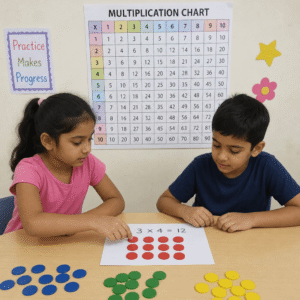
Begin by explaining that multiplication is a shortcut for adding the same number again and again. For example, 4 × 3 means 4 groups of 3, or 3 + 3 + 3 + 3. Use objects so the child can physically see the groups.
Try this quick activity:
- Place 3 rajma beans in one row.
- Make 4 such rows.
- Ask, “How many beans are there in each row?”
- Ask, “How many rows are there?”
- Count all the beans together.
- Say clearly, “Four groups of three are twelve, so 4 × 3 = 12.”
Repeat with pencils, crayons, bangles, or toy cars. Once the child understands the grouping, write the number sentence. This connects the visual activity to the written table.
A useful teaching strategy is to let the child build the groups instead of only watching you. When children move objects themselves, they are more likely to understand what the table means.
2. Teach skip counting before full tables
Skip counting is the bridge between addition and multiplication tables. Before asking a child to recite the 6 times table, help them count 6, 12, 18, 24, and so on. This reduces the memory load because the child learns the rhythm of the number pattern.
Use claps, steps, or jumps to make it active:
- Choose one table, such as 5.
- Ask the child to clap while saying 5, 10, 15, 20.
- Write the numbers in a line.
- Circle the last digit in each number.
- Ask what pattern they notice.
For the 5 times table, children quickly see that answers end in 5 or 0. For the 10 times table, they notice that a zero is added after the number. For the 2 times table, they recognise even numbers.
You can also use stairs. Each step is one count: 3, 6, 9, 12. This turns revision into movement and is especially helpful for energetic kids who do not enjoy sitting still for long.
3. Teach easy tables first
Do not teach tables strictly from 1 to 20 if the child is struggling. Build confidence with easier tables first, then move to harder ones. A good order is 1, 2, 5, 10, 11, 3, 4, 6, 9, 8, 7, and 12. Many schools in India expect children to learn up to 20, but the foundation should be strong up to 12 before extending further.
Use what the child already knows. If they know 2 × 6 = 12, explain that 6 × 2 is also 12. This is called the commutative property, but you do not need to use the term with younger children. Simply say, “The order changes, but the answer stays the same.”
Try this example:
- 3 × 4 means 3 groups of 4.
- 4 × 3 means 4 groups of 3.
- Both have 12 objects in total.
This one idea almost halves the number of facts children feel they must memorise.
4. Use patterns to make memorisation easier
Patterns make tables less scary. Children enjoy spotting rules, especially when they can colour or mark them.
Show these simple patterns:
- 2 times table: all answers are even numbers.
- 5 times table: answers end in 5 or 0.
- 10 times table: answers end in 0.
- 9 times table: the digits in many answers add up to 9, such as 18, 27, 36, and 45.
- 11 times table: up to 11 × 9, the digit repeats, such as 22, 33, and 44.
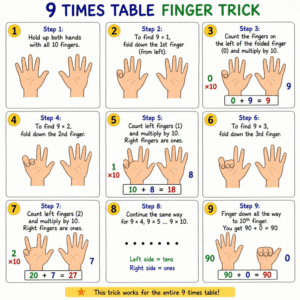
For the 9 times table, try the finger trick. Ask the child to hold up both hands. For 9 × 4, fold the fourth finger from the left. There will be 3 fingers before the folded finger and 6 after it, giving 36. This is not a replacement for understanding, but it is a useful memory support.
5. Practise one table in four small rounds
Instead of saying a table ten times in the same way, divide practice into four mini-rounds. This keeps attention fresh and helps the child recall the table in different formats.
Use this routine:
- Listen: You say the table once while the child follows.
- Repeat: The child says it with you.
- Fill the gap: You say, “6 ones are 6, 6 twos are __.”
- Random recall: Ask mixed questions like 6 × 4, 6 × 9, and 6 × 2.
The final round is important. Many children can recite a table in order but cannot answer when asked randomly. Mixed practice prepares them for school tests, mental maths, and everyday calculations.
Keep corrections gentle. If the child says 6 × 7 = 40, ask them to go back from 6 × 5 = 30 and count 36, 42. This teaches recovery instead of making them feel they have failed.
6. Add educational games for daily practice
Educational games make repetition enjoyable, which is exactly what tables need. The trick is to keep games short, clear, and focused on one or two tables at a time.
Multiplication card match
Write questions on one set of cards and answers on another. For example, write 4 × 6 on one card and 24 on another. Spread the cards face down and ask the child to find matching pairs.
Steps:
- Start with one table, such as the 4 times table.
- Use only 6 to 8 pairs at first.
- Let the child turn over two cards at a time.
- If the pair matches, they keep it.
- If not, they place it back and try again.
This game builds memory, attention, and table recall together.
Table hopscotch
Draw a hopscotch grid with chalk and fill each box with answers from a table, such as 7, 14, 21, 28. Call out “7 × 3” and the child jumps to 21.
This works well in a corridor, balcony, classroom, or playground. It is especially useful for children who learn better through movement.
Dice multiplication
Roll two dice and multiply the numbers. If you want to practise bigger tables, use number cards instead of dice. For example, if the cards show 8 and 6, the child answers 48.
Make it cooperative rather than competitive at first. You can say, “Let us try to get 10 correct answers together.” This reduces pressure and keeps the game positive.
7. Connect tables with drawing and visual charts
Some children remember better through images. Ask them to draw arrays, number lines, or table ladders. For example, for 3 × 5, they can draw 3 rows with 5 dots in each row. Then they count all dots and write 15.
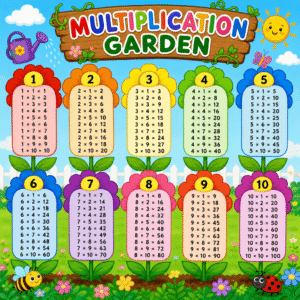
Create a colourful multiplication chart, but do not use it only for copying. Ask the child to look for patterns:
- Which answers repeat?
- Where do the 2 and 4 tables connect?
- Which boxes are easy?
- Which boxes need more practice?
You can also create or use an AI-generated image of a bright multiplication garden, where each flower shows one table. Visual themes make charts more inviting for younger learners.
How can you help a child who forgets tables quickly?
If a child forgets tables quickly, reduce the amount, revise more often, and connect each fact to a method. Forgetting usually means the child needs spaced practice, not scolding or longer copying work. Short revision sessions across the week are more powerful than repeating a full page once.
Use a simple weekly revision plan:
- Day 1: Learn one new table with objects and skip counting.
- Day 2: Revise it orally and play one game.
- Day 3: Ask random questions from the same table.
- Day 4: Mix it with an older table.
- Day 5: Use word problems from daily life.
- Weekend: Play a fun quiz or card game.
For example, if the child is learning the 8 times table, ask real-life questions: “If one auto has 3 wheels, how many wheels do 8 autos have?” or “If 8 children each get 4 toffees, how many toffees are needed?” Word problems help tables become useful knowledge.
8. Use short written practice wisely
Writing tables can help, but copying the same table many times is not enough. Mix writing with thinking. Ask the child to complete missing answers, correct mistakes, or write related facts.
Try these quick written activities:
- Fill in blanks: 7 × __ = 42
- Match facts: 8 × 3 and 3 × 8
- Circle wrong answers: 6 × 5 = 35
- Write the next three: 12, 18, 24, __, __, __
- Create two word problems using the 4 times table
This kind of practice checks understanding and recall. It also prepares children for worksheets and exams without making tables feel like endless copying.
9. Build speed only after understanding
Fast answers are useful, but speed should come after the child understands the table. If you start with timed tests too early, some children panic and make more mistakes. First aim for correct answers, then gradually improve pace.
Use a timer in a friendly way:
- Choose 10 questions from tables the child has already learnt.
- Give enough time so the child can succeed.
- Record the score, not as a punishment, but as a personal challenge.
- Repeat after two or three days and celebrate improvement.
Say, “Let us beat your previous score,” rather than “You are too slow.” Confidence matters. A child who feels capable will practise more willingly.
10. Keep revision mixed, playful, and consistent
The final step is consistency. Tables are not mastered in one day; they become automatic through repeated, meaningful exposure. Mix oral chanting, object grouping, skip counting, games, written work, and real-life questions.
A balanced 15-minute practice session can look like this:
- Two minutes of skip counting
- Three minutes of table recitation
- Five minutes of an educational game
- Three minutes of random questions
- Two minutes of praise and correction
End every session with one thing the child did well. For example, “You remembered 6 × 8 today,” or “You found the pattern in the 9 times table.” Small success builds long-term interest.
Want extra support? Try Foxbrain abacus classes
If your child needs a structured way to strengthen calculation skills alongside table practice, Foxbrain offers abacus classes for kids that focus on faster calculation and mental math. Abacus training helps children visualise numbers, improve concentration, and build confidence with accuracy and speed—skills that make multiplication tables and overall maths practice feel easier over time.
If you want to explore it, you can reach out to Foxbrain to learn about class formats, age-appropriate levels, and how abacus practice can complement the table-learning strategies in this blog.
Common mistakes to avoid
Avoid teaching too many tables together, especially the difficult ones like 7, 8, and 12. Do not rely only on rote learning, because children may recite correctly but fail to use tables in sums. Also avoid comparing siblings or classmates, as this can create fear around maths.
Instead, focus on progress. If the child knows five more facts this week than last week, that is real improvement. With the right teaching strategies, regular revision, and enjoyable educational games, learning tables can become a daily habit rather than a daily struggle.