
Blog
Unlock Mental Arithmetic Mastery: Abacus Techniques
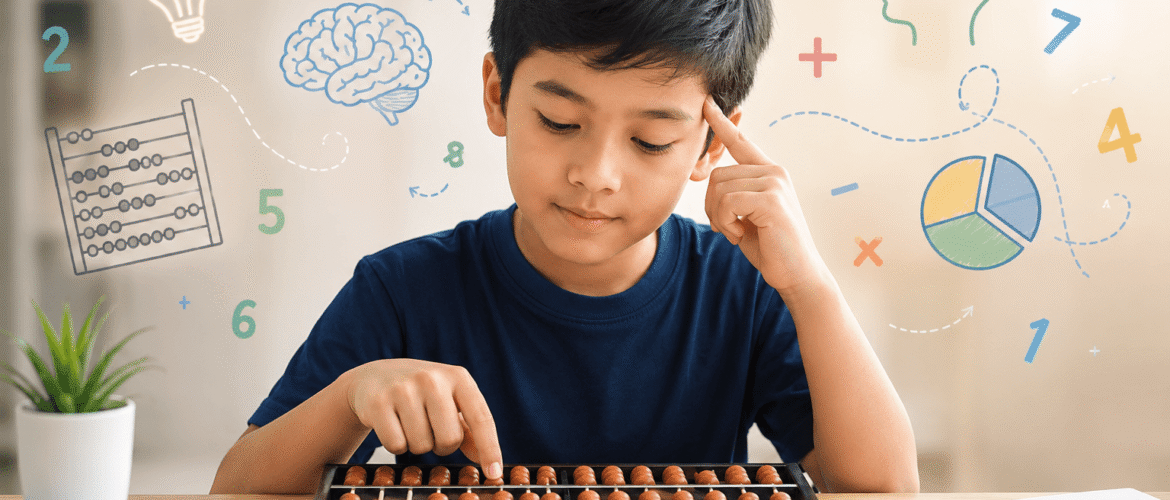
Imagine watching a young child add, subtract, multiply, and divide massive numbers in their head faster than you can type them into a calculator. It looks like magic, but it is actually the result of mastering a centuries-old tool. The fascinating world of abacus and mental arithmetic offers a unique, highly effective pathway to mathematical mastery.
In an era dominated by digital screens and automated calculators, returning to a tactile, physical counting tool might seem counterintuitive. However, this ancient instrument remains one of the most powerful educational tools available today. Let’s dive into how mastering this physical framework translates into astonishing mental agility.

The Anatomy of an Ancient Calculator
Before a student can perform lightning-fast mental math, they must first understand the physical tool. The foundation lies in understanding beaded counting frame mechanics. An abacus is divided into upper and lower decks, where specific bead placements represent distinct numerical values.
When choosing an instrument, parents and educators often wonder about the soroban vs suanpan differences.
- The Suanpan: The traditional Chinese abacus features two “heavenly” beads in the upper deck (each worth five) and five “earthly” beads in the lower deck (each worth one). It was designed to accommodate hexadecimal (base-16) weight measurements alongside base-10 calculations.
- The Soroban: The Japanese adaptation streamlined the design to a base-10 system, featuring just one bead in the upper deck and four in the lower deck. Because it perfectly aligns with modern decimal mathematics, the soroban is the preferred choice for contemporary education.
Why It Works: The Neuroscience Behind the Beads
Parents and educators frequently ask: exactly how does abacus improve brain development? The answer lies in how the brain processes multisensory information.
Unlike traditional rote memorization, abacus training requires both hands. There are profound cognitive benefits of finger movement; stimulating the nerve endings in the fingertips simultaneously activates both the left (logical) and right (creative) hemispheres of the brain.
Furthermore, learners actively develop spatial reasoning skills through bead manipulation. As they physically move the beads up and down to form numbers, they are creating a mental map of mathematical concepts. This holistic brain workout is directly responsible for significantly improving concentration and memory retention, benefits that frequently spill over into a student’s reading comprehension and overall academic performance.
Early Education: Setting Kids Up for Success
A common question among parents is what age to start learning mental math. While adults can certainly learn, the optimal window for mastering these skills is between the ages of 4 and 8. During this period, a child’s brain is highly plastic and readily absorbs new logical frameworks.
Teaching mental math to preschoolers might sound intimidating, but it is highly effective when introduced as a tactile game. Early exposure focuses on building number sense in children. Instead of viewing the number “7” as an abstract, meaningless squiggly line, a child sees it tangibly: one upper bead (5) and two lower beads (2) pushed together.
This tangible approach is the absolute best method for overcoming math anxiety with visual learning. When numbers are something a child can physically touch, move, and control, the fear of abstract mathematics completely vanishes.

Practical Application: Learning the Ropes
When embarking on soroban training for beginners, consistency is more important than duration. Just 15 minutes of daily practice yields better results than an hour once a week.
A great starting point for novices is learning step-by-step addition using the 4-1 rule. Because the modern soroban only has four earthly beads (worth 1 each) and one heavenly bead (worth 5), students must learn “complementary numbers” to calculate. For example, if a child wants to add 4, but only has one lower bead available, they apply a simple rule: pull down the 5-bead (add 5) and push down one 1-bead (subtract 1). Learning these mechanical rules turns complex arithmetic into a fluid, almost musical rhythm of finger movements.
Navigating Different Educational Approaches
As parents research educational enrichment, they often compare different math strategies. A frequent debate is abacus vs vedic maths for kids.
- Abacus relies on a visual and tactile framework. It is ideal for younger children because it treats math as a spatial puzzle.
- Vedic Math is rooted in ancient Indian algorithms and algebraic word formulas. It is highly effective for rapid calculation but is generally better suited for older children (ages 8+) who already have a firm grasp of abstract number theory.
From Physical Beads to Mental Mastery
The true magic happens when the physical abacus is entirely removed from the equation. After months of physical practice, students transition to the visualization method for rapid calculation.
During this phase, the student creates a high-definition image of the soroban in their mind’s eye. When they hear a math problem, their fingers naturally twitch in the air—moving imaginary beads on an imaginary frame. Because the brain processes visual imagery thousands of times faster than abstract text, the student can arrive at the correct answer almost instantly.
This cognitive superpower is perhaps best showcased in international competitions. If you have ever watched a mental arithmetic tournament, you have likely witnessed flash anzan competition techniques. In Flash Anzan, dozens of large numbers flash onto a screen for a fraction of a second. Using their visualized mental abacus, competitors can sum up 15 or 20 three-digit numbers in less than three seconds. It is a breathtaking display of human potential.

Conclusion
Embracing the world of the abacus is about much more than just getting an A+ on a math test. It is a comprehensive cognitive workout that reshapes how the brain processes information. By introducing tactile, visual frameworks to young learners, we equip them with tools to navigate a complex world with confidence.
Whether you are looking to boost a child’s focus, eradicate their fear of numbers, or simply teach them an impressive new skill, mastering mental math through this ancient counting frame is an investment that pays lifelong dividends.