
How is abacus training connected to mental math?
In this era of calculators and smartphone apps, you might wonder why a tool invented thousands of years ago and making a massive comeback in modern classrooms.
For parents navigating today’s competitive academic landscape and the goal isn’t just to help a child pass a math test – it’s to build mental clarity, speed and confidence. This is where the connection between abacus classes for kids and mental math become a superpower for young learners.
The bridge between physical and mental
Many of us think abacus mental math is a simple calculator but in reality, it is a brain training device.
1. The power of visualization
The secret sauce of abacus training is a process called image abacus.
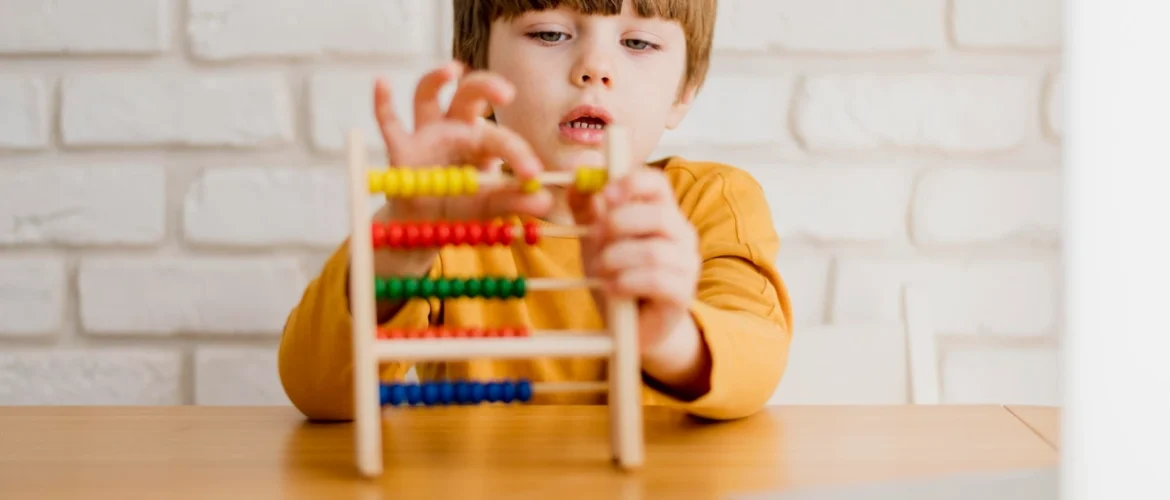
- Phase1: children move physical beads engaging with their sense of touch and sight
- Phase2: they Imagin the beads in their mind’s eye while calculating.
- Phase3: They perform complex calculations by visualising moving those mental beads at lightning speed.
2. Whole – brain development
Unlike traditional method, abacus math program helps in memorization which is primarily uses the left hemisphere of the brain logic, the abacus forces the right hemisphere to work in tandem. This whole brain approach is what allows abacus to solve 456 *7 in second without a pencil and notebook.
Why Mental math matters
Mental math isn’t just a party trick to impress your relative in front of family gathering but it’s foundational life skill. When a child learns mental calculation using abacus, they gain:
- Reduced Math anxiety – number become friends not your enemies.
- Sharper concentration – visualizing beads in mind requires intense focus which spills over into other subjects like reading and science.
Real world readiness – from calculating a discount at a store to manging time during an exam but quick mental math is a lifelong asset.
Did you know? Research shows that brain plasticity is highest between the age 5 and 14 that make this the “Golden age” to start Abacus Classes for kids.
Brain plasticity – it also known as neuroplasticity, this is brain’s natural ability to change, adapt, and reorganize itself by forming new neural connections throughout life.
How physical beads become mental speed
You will amaze when you see how the shift from a wooden frame to lightning – fast mental calculation isn’t just magic – it’s a sophisticated cognitive change. This process is known as “Anzan” a mental calculation, and it happens in three distinct stages:
Stage 1 – the tactical foundation (physical)
In the beginning of abacus math program, abacus acts as a “concrete” anchor. Where children use their fingertips to flick beads up and down to calculate. This tactile movement become muscle memory for number. Instead of seeing an abstract digit like 7 they visualise it in a specific pattern of beads.
Stage 2 – the mental blueprint (visualization)
When child becomes proficient in abacus mental math, then physical abacus removes. Students are taught to close their eyes and “visualise” a vivid, high – definition image of the abacus in their mind. When they hear a number, they don’t think of the symbol they see beads shifting on their internal screen.
Stage 3 – the high-speed calculation
This is where the transformation is complete and because the brain can move “mental” bead much faster than physical ones, child can easily solve multi – digit problem in a fraction of a second and this stage achieves two critical goals:
- Dual – hemisphere activation: the left brain handles logical rules of math, while the right side of brain maintains the visual image of the abacus.
- Cognitive endurance: brain becomes conditioned to hold complex information for longer periods and drastically improve short term memory.
Benefits of Abacus – based mental math for children
Abacus classes for kids acts as a “gymnastics for the brain,” strengthening the cognitive muscle used in every other school subject.
- Laser – sharp focus and attention span – in world of digital distraction abacus requires sustained attention that increase the focus and memory of kids.
- The accuracy habit – abacus training builds a unique neurological pathway where speed and precision grow together.
- Radical confidence and “math bravery” – where most kids have math anxiety which leads to cause academic stress. When a child master’s the abacus the mystery of number vanishes which builds self-efficacy and confidence boost.
- Advanced logical reasoning and number sense – instead of memorizing rule (like carrying the one), abacus students see logic on the base 10 system where deep number sense allows them to spot error instantly.
Why abacus training is effective for young learners
Human brain is never more flexible than during the primary school years. In this period of high neuroplasticity is when the brain’s “wiring” is most receptive to new patterns. Abacus training leverages this unique developmental stage in three powerful ways:
1. Engaging the “kinaesthetic” brain
Children learn fast through movement. While traditional math asks a kid to sit still and look at abstracts’ symbols on a page where abacus turns math into a physical activity.
2. Moving from memorization on intuition
Traditional maths often relies on memorizing “trick” or formulas (like “carrying the one”) if a child forgets the rule, they get stuck. Abacus approach for children develops a deep conceptual understanding where don’t just know that 5 + 5 = 10 but abacus create a mathematical intuition that lasts a to lifetime.
3. Strengthen neural pathways
With the help of visualizing the bead movement in mind, it is strengthening the neural connections between the left and right hemispheres of the brain. This training happens during the “golden window” (typically ages 5 – 12). It’s like
paving a road while the cement is still wet once you set the path to quick thinking is there forever.