
Blog
How to Teach Kindergarten Math: A Practical Guide for Parents and Teachers
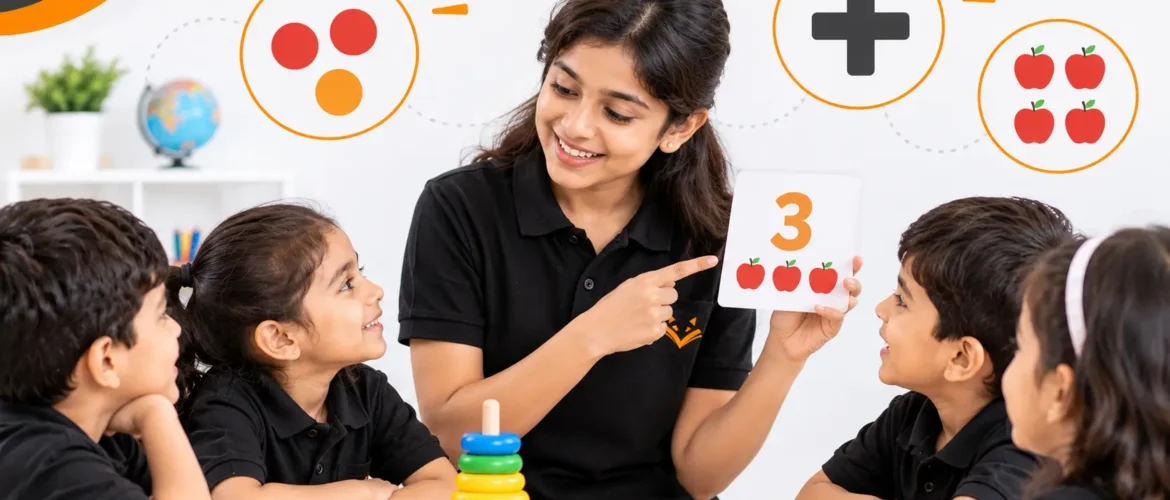
Kindergarten maths is often misunderstood. Many parents picture rows of sums and a notebook full of numbers. In reality, the best kindergarten maths looks more like play: sorting buttons, building towers, setting the table, and arguing over who has more grapes.
That’s not because maths is being watered down. It’s because children aged 5 to 6 learn numbers through things they can touch, move, and talk about, long before they can work with symbols alone. Teach it the other way round (symbols first, understanding later) and many children can complete a worksheet yet have no idea what the numbers mean.
This guide explains what children are expected to learn in kindergarten (called LKG and UKG in many Indian schools), the order to teach it in, and specific activities for each area. If your child is younger and still learning to count, our guide on how to teach numbers to kids covers those earlier steps first.
What Kindergarten Maths Actually Covers
By the end of the year, most children are expected to be comfortable with six areas:
| Area | What your child should be able to do |
|---|---|
| Counting | Count to 100 by ones and by tens; count a group of up to 20 objects accurately |
| Number recognition and writing | Read and write numbers from 0 to 20 |
| Comparing | Say which group has more, fewer, or the same; compare two numbers up to 10 |
| Addition and subtraction | Add and subtract within 10 using objects, pictures, and stories |
| Shapes | Name and describe flat shapes (circle, square, triangle, rectangle) and solid shapes (cube, sphere, cone, cylinder) |
| Measurement, sorting, and patterns | Compare lengths and weights, sort objects by a rule, and continue simple patterns |
These come from commonly used kindergarten standards. Indian boards and schools vary a little in what they emphasise, so check your child’s syllabus, but the foundations are nearly identical everywhere.
The Principle That Makes Everything Easier: Concrete, Then Picture, Then Symbol
The most reliable teaching approach, used in many high-performing maths systems, moves through three steps:
- Concrete: The child works with real objects they can pick up (counters, blocks, beads, fruit).
- Pictorial: They move to drawings or dots that represent those objects.
- Abstract: Only then do they work with numerals and symbols like 3 + 2 = 5.
Skipping to step 3 is the single most common reason children seem to “hate maths.” When a child struggles with a symbol-only question, don’t just explain it again. Go back one step and use objects.
Two other habits help throughout:
- Keep sessions short. Ten to fifteen focused minutes, four or five days a week, works far better than one long session.
- Ask for explanations. “How did you work that out?” and “Show me with the counters” tell you more than whether the answer is right.
Teaching Each Area
1. Counting and number sense (to 20, then to 100)
Counting is more than reciting. Your child needs to touch each object once, know that the last number said is the total, and eventually count without starting from one every time.
- Count everything. Stairs, spoons, shoes at the door. Let them count and tell you the total.
- Count out, not just count. “Can you bring me seven pencils?” is harder than counting seven that are already lined up.
- Teach the teens carefully. Numbers 11 to 19 confuse many children, because their names don’t follow a clear pattern (“eleven,” “twelve”). Show a ten-frame or a bundle of ten sticks plus a few more, so they see that 14 is ten and four more. This idea is the first step toward place value.
- Count to 100 in chunks. Practise counting by tens (10, 20, 30…) first, then fill in the numbers between. A hundred chart on the wall helps a lot.
2. Comparing numbers
Comparison builds the sense that numbers have size.
- Put out two small piles of objects. Ask which has more, and how they know. Then line them up one-to-one to check.
- Use everyday situations: “Who has more stickers, you or your sister?”
- Introduce words like more, fewer, same, greater, less. These words appear in school questions and are easy to overlook.
3. Addition and subtraction within 10
Children should understand what addition and subtraction mean before memorising facts.
- Start with stories. “You have 3 mangoes and I give you 2 more. How many now?” Act it out with real objects.
- Use ten-frames. Place counters in a 2×5 grid. Children see at a glance that 7 is “5 and 2,” or “3 away from 10.” This visual picture later makes mental maths far easier.
- Teach number bonds. Show that 5 can be split as 4 and 1, or 3 and 2, using two-colour counters. Knowing the pairs that make 10 (1 and 9, 2 and 8…) is one of the most useful kindergarten skills.
- Move gently to symbols. Once a child can solve stories with objects, write the matching equation next to them so they link the two.
- Don’t ban fingers. Using fingers is a natural stage. Over time, the visual patterns above help children move beyond counting every finger.
4. Shapes
Shapes teach children to look carefully and describe what they see.
- Go on a shape hunt. Find circles (a plate, a clock), rectangles (a door, a book), triangles (a samosa, a roof).
- Talk about features. “How many sides? How many corners?” matters more than naming the shape.
- Build with them. Use sticks and clay to make shapes, or combine two triangles to make a square. Building with blocks introduces solid shapes (cubes, cylinders) in a natural way.
- Include odd orientations. A triangle turned upside down is still a triangle. Many children get this wrong if they’ve only seen shapes drawn one way.
5. Measurement, sorting, and data
- Compare directly. Which pencil is longer? Which bag is heavier? Let them hold and line up the objects.
- Measure with non-standard units. “How many hands long is the table?” or “How many blocks tall is the teddy?” builds the idea of measurement before rulers.
- Sort by a rule. Give a pile of mixed buttons and ask them to sort by colour, then by size. Ask them to invent their own rule.
- Make a simple graph. Count and compare favourite fruits among family members using a drawn bar chart.
6. Patterns
Patterns are the early foundation of algebra.
- Start with simple AB patterns (red, blue, red, blue) using beads, claps, or blocks.
- Move to AAB, ABC, and patterns with sounds and movements (“clap, clap, stomp”).
- Ask: “What comes next? What’s the rule?” and encourage them to make their own for you to guess.

A Simple Weekly Routine
You don’t need a rigid timetable, but a loose rhythm helps. For example (about 15 minutes a day):
- Monday: Counting game plus a number hunt around the house
- Tuesday: Addition story with objects or ten-frames
- Wednesday: Shape or pattern activity
- Thursday: Comparing and measuring something real
- Friday: A maths game (ludo, snakes and ladders, or a card game)
Rotating through areas keeps things fresh and revisits skills often, which matters more than long drills.
Five Common Mistakes
1. Rushing to worksheets. Paper exercises are the last step, not the first.
2. Memorising without understanding. A child who recites “2 + 3 = 5” but can’t show it with objects will struggle once the questions change.
3. Correcting without diagnosing. When an answer is wrong, ask the child to show you how they got it. The mistake is often in counting, not in understanding.
4. Making it feel like a test. Anxiety shuts down learning at this age. Keep the tone playful, and celebrate effort.
5. Comparing with other children. Children reach these milestones at different times, and several months’ difference is normal.
How to Tell Your Child Is on Track
By the end of the year, your child should generally be able to:
- Count a group of up to 20 objects and tell you the total without recounting
- Recognise and write most numbers up to 20 (some reversals are normal)
- Say which of two groups has more and explain why
- Solve simple add and subtract stories within 10 using objects or drawings
- Name basic shapes and describe how they differ
If your child finds several of these very difficult, consider speaking with their teacher. Often a gap can be closed with short, targeted practice at the right stage, and the earlier it’s addressed, the easier it is.
Frequently Asked Questions
Should kindergarteners learn to read and write numbers or just understand quantities?
Both, in that order. Understanding quantity comes first. Writing numerals follows, and handwriting often lags behind understanding, so don’t judge number knowledge by neatness.
Is it okay for my child to use fingers to add?
Yes. It’s a normal stage. Ten-frames, number bonds, and games gradually help children move to quicker mental strategies.
How much time should we spend on maths each day?
Ten to fifteen minutes of focused activity is plenty, plus the natural counting and comparing that happens during the day.
Should I teach multiplication or fractions in kindergarten?
Not formally. Sharing sweets equally or halving a chapati is useful informal exposure, but the priority this year is solid understanding of numbers to 20 and addition and subtraction within 10.
My child is bored with basic counting. What should I do?
Extend with challenges rather than speeding ahead: count by twos and fives, make patterns, play “make 10” games, or invent number stories. Depth is better than rushing to harder topics.
When is a child ready for structured maths programmes like abacus?
When they’re comfortable with numbers to 10, can recognise and write most digits, and enjoy hands-on activity. Around age 5 or 6 is the usual starting point.
At Foxbrain, our Abacus and Vedic Maths programmes pick up where kindergarten maths leaves off, turning a child’s early number sense into fast, confident mental calculation. If your child is ready for the next step, we’d be happy to help you find the right starting point.