
Blog
How to Teach Alphabets to a 3 Year Old: A Simple Guide for Indian Parents
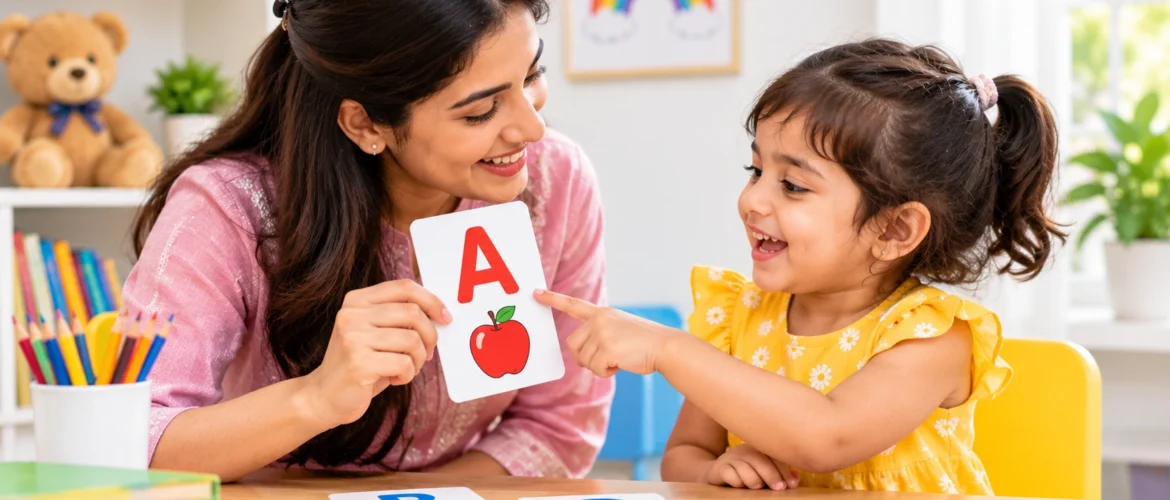
Quick answer: Start with the letters in your child’s own name, not with “A.” Teach each letter’s name and its sound together. Use play, such as finding letters on shop boards, tracing in a tray of rice, or building with clay. Keep it to 10 minutes a day. Go slowly, with just 2 or 3 new letters at a time, and keep reviewing old ones. At age 3, the goal is to recognize letters and hear their sounds. Writing can wait.
If your 3-year-old knows only a few letters, or none, that is completely normal. This guide shows you where to begin and how to make it fun.
Does my 3-year-old need to know the alphabet?
No. At 3, there is no need to know all 26 letters. Some children know a few letters. Some know none. Both are normal.
What matters at this age is that your child:
- Enjoys songs, rhymes, and books
- Listens and speaks in short sentences
- Is curious about letters and signs around them
If you want to start teaching letters, 3 to 4 years is a good time, as long as it stays playful. If your child resists or gets upset, take a break and try again in a few weeks. There is no prize for starting early, and no harm in starting a little later.
If you want to know what else is worth teaching at this age, read our guide on [what to teach a 3 year old].
Why you should NOT start with A, B, C
Most of us learned A to Z in order. But research does not show that alphabet order is the best way to teach. Here is what experts suggest:
- Start with the letters in your child’s name. These letters mean something to your child. Children usually learn the first letter of their own name before any other letter.
- Mix easy and harder letters. Some letters are easier to learn than others, such as letters whose names hint at their sounds (B says “bee,” and starts with /b/).
- Don’t do “one letter a week” and then forget it. Letters need to come back again and again. Reviewing old letters while adding new ones works better.
- Teach letters in real life, not alone. Children remember letters better when they are part of something meaningful, such as a name, a favourite book, or a shop sign.
Teach the letter’s name AND its sound together
This is the most important tip.
A letter has a name (the letter “B” is called “bee”) and a sound (it says /b/ as in “ball”). Research suggests teaching both together works best. The name helps your child talk about the letter. The sound helps your child read and spell later.
Say it like this: “This is B. B says /b/.” (Say the sound short and clean: /b/, not “buh.”)
The “A for Apple” trap
In many Indian homes and schools, children learn “A for Apple, B for Ball, C for Cat.” It is a nice routine, but it has two problems.
- Children often remember the picture, not the sound. Ask your child, “What sound does A make?” and they may say “Apple.” That is the word, not the sound.
- Some letters give confusing examples. “C for Cat” is fine, but “C” also says /s/ in “city.” “X for Xylophone” is rare and starts with a /z/ sound. Instead, say: “X is at the end of ‘fox’ and ‘box’.”
A better way: Keep the pictures, but add the sound. Say, “A, /a/, apple. /a/ /a/ apple.” The sound comes first, then the word.
One more tip for Indian families: Many Indian schools say “Zed” for Z, and others say “Zee.” Pick the one your child’s school uses, and stay with it, so your child is not confused.
The 6-step method to teach alphabets
Step 1: Begin with your child’s name
Write your child’s name in big letters. Point to each letter and say its name and sound. Show your child the name on their bag, bottle, or bedroom door.
Example: “R-I-Y-A. R says /r/. Riya starts with R.”
Step 2: Add 2 or 3 new letters at a time
After the name letters, add a few more. A common choice is S, A, T, P, I, N, because they make many simple words (sat, pin, pat, tip). But this is not the only order. You can also pick letters from your child’s favourite things, like “M” for Mummy or “D” for Dada.
Go slowly. Add 2 new letters about every week or two. Keep playing with the earlier ones.
Step 3: Match and find
Before asking your child to say a letter, ask them to find it. This is easier. Say, “Show me the letter S,” and let your child point.
Then go the other way. Point and ask, “What is this one?”
Step 4: Hunt for letters in real life
The alphabet is everywhere in India. Try these:
- Shop name boards and hoardings
- Trucks and auto-rickshaws (“Horn OK Please” is a favourite!)
- Biscuit and chocolate packets (“P for Parle-G”)
- Milk packets, medicine strips, and toothpaste boxes
- Pages of English newspapers and children’s books
Game: “Today we are finding the letter M. Let’s find three Ms on our walk.”
Step 5: Feel the letters before writing them
Three-year-olds are not ready for pencil and paper writing. Their small hand muscles are still growing. Let them feel and trace the shapes instead.
- Write letters in a thin layer of rice, atta, or sooji on a steel plate
- Roll clay or atta dough into snakes and form letters
- Trace in the air with a finger or a ribbon
- Draw with chalk on a wall or floor
- Use finger-paint on a big sheet
Step 6: Keep reviewing, just a little each day
Do not wait for your child to “master” one letter before moving on, or move on and never come back. Spend one minute each day on old letters, and two minutes on new ones.
A sample 4-week plan
| Week | What to do |
|---|---|
| 1 | Letters in your child’s name. Name and sound. Find them on bag, bottle, and door. |
| 2 | Keep playing with name letters. Add 2 new letters (for example S and A). Letter hunt on a walk. |
| 3 | Review all letters so far. Add 2 more (for example T and P). Tray writing with rice. |
| 4 | Review everything. Play a “find the letter” game. Read an alphabet or picture book together. |
Every child is different. If your child needs more time on a step, stay there.
A 10-minute daily routine
- 2 minutes: Sing a short alphabet or rhyme song
- 3 minutes: Play one letter game (find it, match it, or hunt for it)
- 3 minutes: Tray tracing or clay letters
- 2 minutes: Read a picture book and point to one letter you know
Short and happy sessions are better than long, tiring ones.
Fun alphabet games to play at home
- Letter treasure hunt: Hide cards with letters around the room. Your child finds them and says what they see.
- Name puzzle: Cut your child’s name into letters and put it back together.
- Balloon pop: Write letters on balloons. Call out a letter and your child pops that one.
- Alphabet in the kitchen: Make letters with atta dough, or use spoons and steel katoris to find a letter.
- Letter in a bag: Put objects that start with one sound in a bag (for example a spoon, sock, and soap for S). Pull each out and say the sound.
- Magnetic letters on the fridge: Let your child arrange and rearrange.
Common mistakes parents make
- Expecting the whole alphabet quickly. A few letters well known is better than 26 half-known.
- Teaching only the song. The ABC song is fun, but a child can sing it without knowing a single letter. In the song, “L-M-N-O-P” sounds like one long word.
- Pushing writing too early. Let the hands get strong first through play.
- Using worksheets. At 3, hands-on play works much better.
- Showing only capital letters. Show both capital and small letters, since books mostly use small ones.
- Getting upset about mix-ups. Mixing up letters that look alike (like b and d) is very common in young children and usually gets better with time.
If your child finds some sounds hard
Some children say “w” for “v” or “d” for “th.” This is common and usually settles with time and practice, especially in homes where more than one language is spoken. If you also feel your child is hard to understand, our guide on [4 year old not speaking clearly] explains what is normal and when to get a check-up.
When to talk to a doctor or specialist
Every child grows at their own speed. But talk to your pediatrician if your child:
- Does not speak in short sentences by age 3
- Does not respond to their name or simple instructions
- Shows little interest in books, songs, or play
- Has lost skills they had earlier
How FoxBrain classes can help
Home is the best place to begin. But some children enjoy learning letters with other children and a trained teacher.
Our Phonics and Spoken English class at FoxBrain teaches letters through sounds, songs, stories, and games. Children learn to hear a sound, match it to a letter, and use it to read simple words. They also practice speaking, which improves how clearly they say English sounds.
Our Brain Gym class builds balance, coordination, and hand control. These skills help children hold a pencil and write letters comfortably when they are ready.
Frequently Asked Questions
At what age should a child learn the alphabet?
Children can begin to learn letters from around 3 to 4 years through play. There is no fixed age. Many children learn most letters between ages 4 and 5. What matters is that learning is fun and not forced.
What is the best way to teach alphabets to a 3-year-old?
Start with the letters in the child’s name. Teach the name and sound of each letter together. Add 2 or 3 new letters at a time, use real-life letter hunts and tray tracing, and review old letters every day.
Should I teach capital or small letters first?
You can show both. Start with whichever letters are in your child’s name, then add the other form. Children see small letters most often in books, so it helps to know both.
Should I teach letter names or letter sounds first?
Teach them together. The name helps your child talk about the letter, and the sound helps them read and spell later.
My 3-year-old can sing the ABC song but doesn’t know the letters. Is that okay?
Yes, this is very common. Singing is a good start. Next, play games where your child finds, matches, and names single letters.
Should I teach English alphabets or Hindi and Gujarati varnamala first?
You do not have to choose. Children can learn more than one script over time. Keep both playful and slow. Use the language of the home for stories and songs, and introduce English letters through games and daily life.
Should my 3-year-old learn to write alphabets?
Not yet. Let your child trace in rice or atta trays, play with clay, and scribble. Most children are ready for proper letter writing around 4.5 to 5.5 years.