
Blog
How to Teach Numbers to Kids: A Step-by-Step Guide for Parents
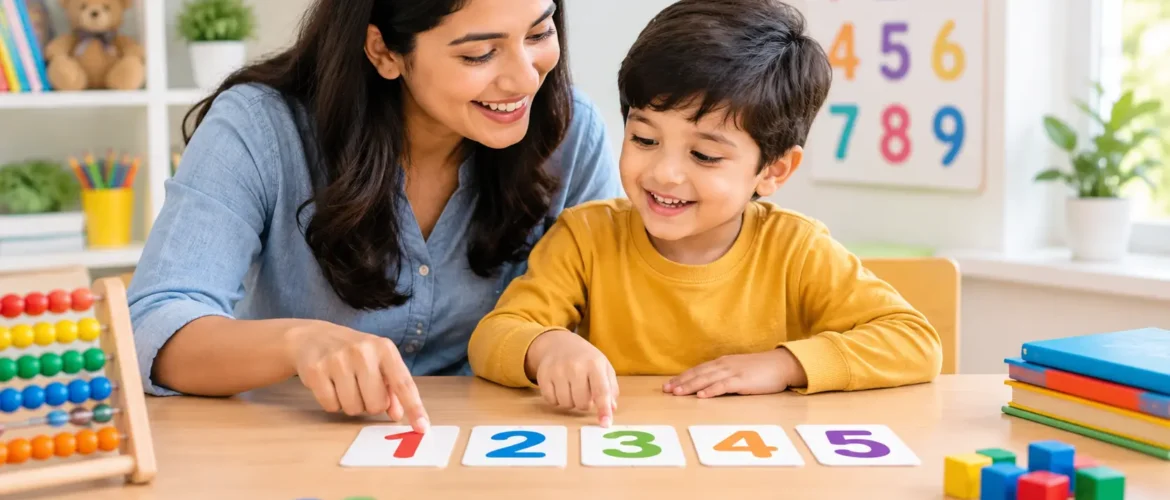
Most parents start teaching numbers the same way: they sit the child down, say “one, two, three, four,” and wait for it to stick. Often the child can recite the numbers perfectly, and then falls apart the moment you ask, “Can you give me three biscuits?”
That gap is the whole problem. Reciting numbers and understanding numbers are two different skills, and most children learn them separately and in a specific order. If you teach them in the wrong order, or only teach the first one, your child can look fine at home and still struggle when school maths begins.
This guide walks through the order children actually learn numbers in, what to do at each stage, and how to tell when it’s time to move on.
First, Understand What “Knowing Numbers” Really Means
When a child “knows numbers,” they’re actually combining five separate abilities:
- Saying the number words in order (one, two, three…). This is memorization, like a song.
- One-to-one matching. Touching or moving one object for each number word, without skipping or double-counting.
- Knowing the last number is the total. When a child counts five blocks and you ask “how many?”, they should answer “five” without recounting. This is called the cardinality principle, and it’s the biggest turning point in early maths.
- Recognizing the written digit. Seeing “5” and knowing it means five.
- Number sense. Understanding that 5 is more than 3, that 5 is made of 2 and 3, and that numbers have sizes.
Most children can do step 1 long before steps 2 and 3. That’s why a three-year-old can count to twenty and still get “how many?” wrong. Nothing is wrong with them. They’re simply at step 1.
The Right Order to Teach (and Rough Ages)
Ages here are typical, not deadlines. Children vary a lot, and a few months either way is completely normal.
Stage 1: Counting words and rhythm (about ages 2 to 3)
At this stage, numbers are language. Don’t expect meaning yet. Build familiarity:
- Count naturally through the day: stairs, steps to the gate, grapes on a plate.
- Use counting songs and finger rhymes, which give the number sequence a rhythm that’s easy to remember.
- Count backwards occasionally (“blast off!”) so the sequence isn’t only learned as a fixed chant.
Common mistake: Pushing for high numbers. Counting confidently to 10 and meaning it is worth far more than chanting to 50 without understanding.
Stage 2: One-to-one matching (about ages 3 to 4)
This is where counting becomes real. The child must connect one spoken number to one object.
- Use small groups of real objects (3 to 6 items): blocks, spoons, toy cars.
- Teach them to touch or move each item as they count. Moving counted items to a separate pile prevents counting the same one twice.
- Set the table together: “One plate for each person. How many plates do we need?”
If your child says the numbers faster than they touch the objects, slow down. The words and the touches need to match exactly. This mismatch is the most common reason children miscount.
Stage 3: “How many?” and the last-number rule (about ages 3.5 to 5)
After counting a group, ask: “So how many are there?”
A child who recounts from one has not yet grasped that the last number counted tells the total. A child who answers with the last number has made a genuine leap.
To build this:
- Count a small set together, then pause and emphasize the last number: “One, two, three. Three blocks!”
- Ask “Can you give me four?” and let them take objects from a larger pile. This is much harder than counting, and much more revealing.
- Play shop games: “I’d like three apples, please.”
Don’t move to written numbers until this stage feels comfortable. Digits are only useful once the quantity behind them makes sense.
Stage 4: Recognizing digits (about ages 4 to 5)
Now connect the written symbol to the quantity you’ve already built.
- Pair each digit card with a matching set of objects (the “3” card next to three buttons).
- Hunt for numbers in real life: house numbers, lift buttons, clocks, price tags.
- Let them trace digits in sand, flour, or on a tray before using a pencil. Writing comes later and is a separate physical skill, so don’t judge number knowledge by handwriting.
Expect reversals like writing 3 or 5 backwards. This is very common at this age and usually settles on its own with practice.
Stage 5: Number sense (about ages 5 to 7)
This is the stage that decides how comfortable your child will feel with maths later. It’s about seeing numbers as quantities that relate to each other, not just labels.
- Quick recognition without counting. Show a small dot pattern (like a dice face) for a second. Can they say how many without counting? Children can do this up to about 3 or 4 naturally, and with practice, a bit beyond.
- Number bonds. Show that 5 can be 4 and 1, or 3 and 2. Use two-colour counters or fingers.
- Ten frames. A simple 2×5 grid where children place counters. It makes the structure of 10 visible, which later makes addition and place value far easier.
- More and less. “Which pile has more? How many more?”
This is also the stage where visual tools like the abacus become powerful, because they make quantity and place value something a child can see and touch. If you’re curious how that works, our guide on how abacus training builds mental maths goes into the method in detail.
Five Common Mistakes That Slow Children Down
- Teaching digits before quantity. A child who recognizes “7” but can’t build a group of seven is memorizing shapes, not learning numbers.
- Practising only by chanting. Counting aloud is stage 1. Without objects and “how many?” questions, it never turns into understanding.
- Using worksheets too early. Before about age 5, hands-on counting with real objects teaches far more than paper exercises.
- Rushing past mistakes. If a child miscounts, don’t just correct the answer. Say “Let’s count together, and touch each one.” Fixing the method matters more than fixing the answer.
- Long sessions. Five to ten focused minutes, a few times a week, beats one forty-minute session that ends in tears. Young children’s attention for structured tasks is short, and that’s normal.
Fitting Numbers Into Everyday Life
You don’t need a special setup. The best number teaching happens inside ordinary routines:
- Meals: “How many pieces of roti do you want? Can you give Papa two?”
- Stairs and walks: Count steps, lamp posts, or birds.
- Shopping: Let them count items into the basket, or pick out three bananas.
- Games: Snakes and ladders, ludo, and card games all build counting and number comparison without feeling like practice.
- Tidy-up: “Put five toys in the box. How many are left outside?”
- How to Tell If Your Child Is Ready to Move On
Before moving to the next stage, check these signs:
- Ready for “how many?” questions: They touch each object once and the words match the touches.
- Ready for digits: They can reliably count out a requested number of objects (up to 5 or so) and give the total without recounting.
- Ready for early addition: They understand more and less, and can combine two small groups and count the total.
- Ready for structured maths learning (including abacus): They’re comfortable with numbers to 10, and can recognize and write most digits.
When to Seek Extra Help
Every child learns at their own pace, but consider talking to a teacher or specialist if, by around age 6, your child:
Still can’t count objects reliably up to 10
Consistently confuses quantities (“more” and “less”)
Shows strong distress or avoidance around any number activity
This doesn’t necessarily mean anything is wrong. Often, a bit of targeted, patient practice at the right stage is all that’s needed. But catching a gap early is much easier than fixing it after years of confusion.
Frequently Asked Questions
At what age should I start teaching numbers?
Informal exposure (counting stairs, rhymes) can begin around age 2. More structured work like matching, “how many?” and digits fits best between ages 3 and 5. There’s no benefit to forcing it earlier.
Should my child learn to write numbers first, or understand them first?
Understanding first. Writing is a fine-motor skill that develops separately and often lags behind number knowledge. A child can understand numbers well and still have messy handwriting.
My child can count to 100 but can’t tell me how many objects there are. Is that a problem?
It’s very common and not a problem, just a sign they’re at the “words” stage. Go back to one-to-one matching with small groups and the “how many?” question.
Are apps and videos useful for teaching numbers?
They can help as a supplement, but they work best when a parent is involved. Physical objects and conversation teach quantity far better than tapping a screen alone.
When should we move on to addition and subtraction?
When your child counts small groups accurately, understands more and less, and can combine two groups and find the total. Usually somewhere between ages 5 and 6.
Is my child behind if they learn slower than their classmates?
Early differences are very common and often even out. What matters is a solid foundation at each stage, not speed.
At Foxbrain, our Abacus and Vedic Maths programs are designed for children from age 5 and build on exactly this foundation, taking number sense from concrete counting to confident mental calculation, at a pace that suits each child. If your child is ready for the next step, we’d be happy to help you work out where to begin.