
Blog
What to Teach a 3 Year Old: A Simple Guide for Indian Parents (And What NOT to Rush)
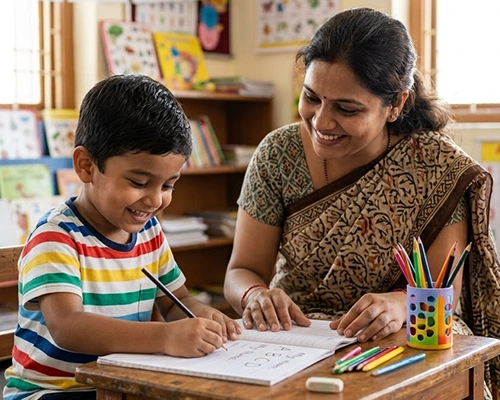
What to Teach a 3 Year Old: A Simple Guide for Indian Parents
Quick answer: At age 3, the best things to teach are talking, listening, movement, sharing, and simple daily habits. Do this through play, stories, and daily routines. You do not need to teach writing, long tables, or full alphabets yet. India’s own early-learning framework (NCF for the Foundational Stage, 2022) says children aged 3-8 learn best through play and activity, not through pressure or worksheets.
If you have felt worried because a neighbor’s child “already writes A to Z,” this guide is for you. Here is what really matters at 3, what you can safely wait on, and how to do it all with 15-20 minutes a day.
Why age 3 is a special age
A 3-year-old’s brain is growing very fast. Your child is moving from “baby talk” to real conversation. They are starting to play with other children. They want to do things “by myself.”
This means age 3 is about building the base, not finishing the syllabus. A strong base in talking, hand control, and confidence makes school learning much easier at ages 5 and 6.
The 5 things to teach a 3 year old
India’s NCF for the Foundational Stage (ages 3-8) groups early learning into five areas. These are physical development, social and emotional development, thinking skills, language and reading, and art and culture. It also adds “positive learning habits.” Here is what that looks like at home for a 3-year-old.
1. Talking and listening (the most important one)
Language is the base of everything, including reading later. By age 3, most children can speak in short sentences. They can answer simple questions like “what is this?” and “where is it?” Most people outside the family can understand much of what they say.
What to teach:
- New words every day. Name things as you cook, shop, or walk.
- Simple rhymes and songs. Rhymes teach the beats and sounds of words.
- Listening games like “bring me the red cup” or “clap when you hear the animal.”
- Telling a story back. After a story, ask, “Who came first? What happened next?”
Easy idea: Ask “why” and “what do you think?” Then wait 5 seconds. Do not answer for your child.
If your child is hard to understand, read our guide on [4 year old not speaking clearly] to know what is normal and what is not.
2. Moving and using hands
Strong hands and a balanced body come before holding a pencil. A child who cannot yet squeeze, pinch, and balance is not ready to write. That is normal at 3.
What to teach:
- Big movements: running, jumping, climbing, kicking a ball, walking on a line
- Small hand skills: squeezing dough, tearing paper, threading big beads, using a spoon, turning pages
- Self-help: taking off shoes, washing hands, drinking from a glass, putting on a simple t-shirt
Easy Indian-home ideas: Let your child knead a little atta dough. Let them pick stones from rice or sort rajma and chana into bowls. Let them pour water between two steel glasses. These are real learning activities and cost nothing.
3. Playing with others and handling feelings
At 3, children start to take turns, notice other kids, and join pretend play. They also have big feelings and small patience. This is normal.
What to teach:
- Taking turns and sharing (it takes practice, and it is okay if it is not perfect)
- Naming feelings: “You are angry because the toy broke. It is okay to feel angry.”
- Saying “please,” “thank you,” and “sorry” by seeing you do it
- Staying calm for a short time when you leave, such as at school drop-off
Easy idea: Play a simple board or ball game where you take turns. Say “my turn, your turn” out loud.
4. Early thinking: sorting, counting, and noticing
Do not push big numbers. At 3, the goal is to understand “what the number means,” not to repeat 1 to 100.
What to teach:
- Counting 1 to 5 with real things (3 laddoos, 4 steps)
- Colours and basic shapes (circle, square, triangle)
- Big and small, many and few, in and out, up and down
- Sorting things by colour, size, or type
- Simple puzzles with 3 to 6 pieces
- Matching pairs, like socks or leaves
Easy idea: When you go to the sabzi mandi, ask your child to find “two tomatoes” or “the biggest onion.”
5. Daily habits and routines
Habits matter more than facts at this age. They are also part of the “positive learning habits” the NCF highlights.
What to teach:
- Putting toys back in a basket
- Sitting for a short story (even 5 minutes is a good start)
- A fixed time to sleep and wake up
- Eating without a screen
- Listening to a simple two-step instruction: “Pick up your bag and put it on the chair.”
What NOT to rush at age 3
Many parents feel pressure from schools or neighbours. Here are things you can safely delay.
| Skill | Why it can wait |
|---|---|
| Writing letters and numbers | Hand muscles and focus are still growing. Early writing can cause bad grip and dislike of writing. |
| Long tables (2 to 10) | Memory without meaning does not build real number sense. |
| Full alphabet by heart | Sounds and rhymes matter more than just reciting A to Z. |
| Long hours of study | A 3-year-old can focus for only about 5 to 10 minutes on one activity. |
| Worksheets and “homework” | Hands-on play teaches more than paper work at this age. |
Your child can learn all of these at 5 or 6 and do just as well, often better, if the base was built through play.
A simple 20-minute daily plan
You do not need to make this complicated. Try this:
- 5 minutes: Rhyme or song with actions
- 5 minutes: Story or picture book. Ask 2 or 3 questions.
- 5 minutes: Hand activity (dough, beads, pouring, sorting)
- 5 minutes: Active play (ball, dance, “freeze” game)
Use daily routines as bonus learning. Counting steps, naming vegetables, and talking about the day all count.
Screen time at age 3
The Indian Academy of Pediatrics advises no more than one hour a day of supervised screen time for children aged 2 to 5. Fewer screens usually means more talking, more play, and better sleep. If your child watches something, watch with them and talk about it afterwards.
Signs your 3-year-old may need a check-up
Every child grows at their own speed. But talk to your pediatrician if your 3-year-old:
- Does not speak in short sentences or is very hard to understand
- Does not respond to their name or to simple instructions
- Does not play pretend or show interest in other children
- Has lost skills they had before
- Rarely makes eye contact or does not point to show you things
Getting a check-up early helps. It does not mean something is wrong.
How FoxBrain classes can support your 3 year old
Home is the best classroom at this age. But some children benefit from a little extra structure and a group setting. At FoxBrain, three programs fit this age best:
- Phonics and Spoken English: Builds listening, sounds, rhymes, and first words through songs, stories, and games. It helps children speak clearly and with confidence in English, while their home language stays strong.
- Brain Gym: Uses simple movements and activities to build balance, coordination, and focus. This supports the hand and body skills that come before writing.
- Personality Development: Helps children learn to share, take turns, speak in front of others, and feel comfortable in a group.
Other programs, such as Abacus, Vedic Math, and AI and Coding, are better suited for older children once the base skills are in place. If you are unsure which program suits your child’s age, our team can guide you honestly.
Frequently Asked Questions
What should a 3-year-old know?
A 3-year-old should be able to speak in short sentences, follow simple two-step instructions, and name common objects and colours. They should also be able to run and climb, play next to other children, and do simple tasks like washing their hands with help.
Should I teach my 3-year-old to write?
No, not yet. Focus on hand strength and fun scribbling, drawing, and play with dough and beads. Most children are ready for proper letter writing around age 4.5 to 5.5. Starting too early can cause a weak grip and a dislike of writing.
How can I teach my 3-year-old at home?
Use play, stories, rhymes, and daily routines. Spend 15 to 20 minutes a day on talking, hand activities, and active play. Count real things, name objects, and let your child help with small chores.
Can a 3-year-old learn two or three languages?
Yes. Children in multilingual homes learn languages naturally by hearing them in daily life. Talk to your child in the language you are most comfortable with. Do not stop using the home language to “make English easier.”
How long should a 3-year-old study each day?
Think in minutes, not hours. A 3-year-old focuses for about 5 to 10 minutes at a time. Several short play sessions in a day work better than one long sitting.
Is it okay if my 3-year-old is not going to school yet?
Yes. Many children learn well at home at this age. What matters is daily talking, play, and time with other children. A playgroup or a few weekly classes can help with social skills, but no child “falls behind” by starting a little later.