
Blog
Midbrain Activation for Kids: What Parents Should Know, Benefits & Best Age to Start
Midbrain Activation for Kids: What Parents Should Know, Benefits & Best Age to Start
Every parent wants their child to learn faster, concentrate better and become more confident.
But with school, homework, exams, screen time and multiple activities competing for a child’s attention, many parents look for programs that can support their child’s overall learning abilities.
One such program that has become popular among parents in India is midbrain activation.
But what exactly is midbrain activation? How does it work? What are its benefits? Is it really possible to “activate” a part of the brain? And what is the right age for a child to join a midbrain activation class?
Let’s understand it in simple language.
What Is Midbrain Activation?
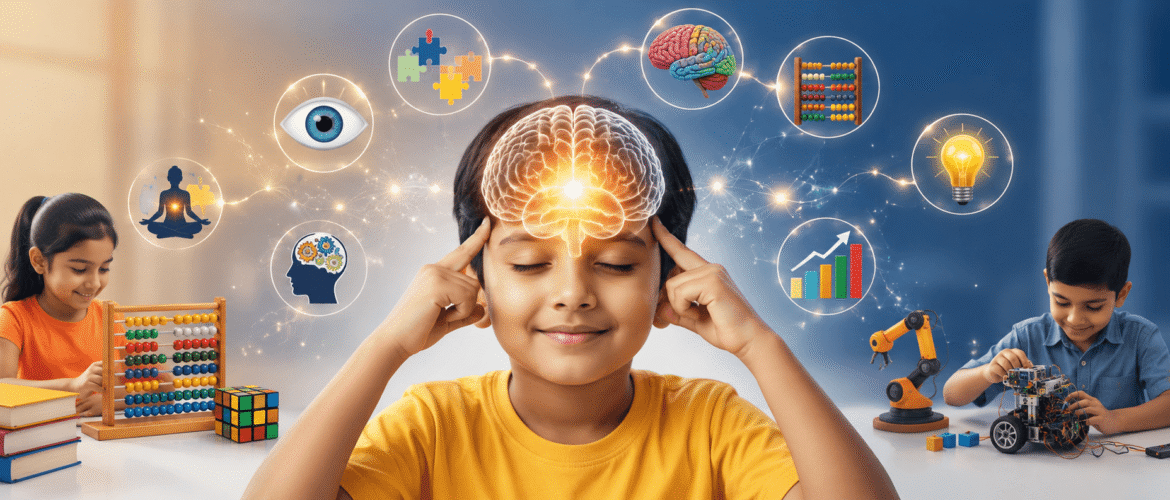
Midbrain activation is a type of brain-development training that typically uses concentration exercises, observation activities, visualization, memory tasks, relaxation techniques and other mental exercises to encourage children to develop learning-related skills.
Many programs use the term “midbrain activation” to describe activities intended to improve a child’s:
- Concentration
- Memory
- Observation
- Creativity
- Visualization
- Confidence
- Learning habits
- Relaxation and mental focus
However, parents should understand an important distinction.
The midbrain is a real part of the brain, involved in several important functions, including movement, vision, hearing and attention-related processes. But the idea that a normally functioning child’s midbrain is “inactive” and can simply be switched on through a special course is not established by mainstream neuroscience.
Similarly, claims that children can read books, identify colours or recognize objects while completely blindfolded because their “midbrain has been activated” do not have strong scientific support.
Therefore, parents should look at these classes as skill-building activities rather than a magical way to unlock hidden brain powers.
Why Are Parents Interested in Midbrain Activation Classes?
Children learn differently.
Some children can sit and concentrate for long periods, while others get distracted easily. Some remember information quickly, while others need repetition. Some are naturally creative, while others need activities that encourage them to express their ideas.
This is why parents are increasingly exploring activities beyond regular academics.
A well-designed brain-development class can give children opportunities to practise skills such as:
Focus → Observation → Memory → Visualization → Problem-solving → Confidence
These skills can complement what children learn at school.
For example, a child may practise remembering patterns during a classroom activity. Another activity may require the child to observe differences between pictures. A relaxation exercise may help the child slow down and focus before starting a task.
The goal should be to make children better learners—not to promise extraordinary abilities overnight
How Does Midbrain Activation Training Work?
There is no single standardized method called “midbrain activation.” Different institutes use different activities and teaching approaches.
A child-development program using this name may include activities such as:
1. Concentration Exercises
Children participate in activities that require them to pay attention to a particular object, sound, pattern or task.
The purpose is to encourage sustained attention and reduce unnecessary distractions during the activity.
2. Memory Activities
Children may be asked to remember:
- Numbers
- Pictures
- Shapes
- Sequences
- Words
- Patterns
These activities make memory practice more engaging than simply asking children to memorize information from a textbook.
3. Observation Games
Observation activities encourage children to notice details.
For example, a trainer might show two similar pictures and ask children to identify differences.
Such activities can make children more attentive to details.
4. Visualization Activities
Children may be encouraged to imagine an object, picture, number or sequence in their mind.
Visualization is commonly used in learning, sports and creative activities because mental imagery can help children engage with information in a different way.
5. Brain Games and Puzzles
Age-appropriate puzzles, patterns, sequencing exercises and problem-solving games can make children think rather than simply memorize.
6. Relaxation and Breathing Exercises
Some programs include simple breathing, relaxation or mindfulness-style activities.
These can help children learn how to pause, settle down and focus before beginning a task.
7. Creative Activities
Drawing, imagination exercises, storytelling, pattern recognition and other creative tasks may also be incorporated into child-development programs.
What Are the Benefits of Midbrain Activation Classes?
Parents often search for the benefits of midbrain activation for children.
It is important to separate reasonable learning-related benefits from extraordinary claims that have not been scientifically established.
A structured program that uses concentration, memory, observation and creative activities may help children practise several useful skills.
1. Better Concentration Practice
Children today are surrounded by distractions.
Concentration activities give them an opportunity to practise staying focused on one task at a time.
This doesn’t mean that every child will suddenly develop extraordinary concentration, but regular practice can make focusing a more familiar skill.
2. Memory Practice
Memory games can encourage children to remember information through patterns, images, sequences and repetition.
This can make memory training enjoyable and interactive.
3. Improved Observation Skills
Observation exercises encourage children to notice small details.
This can be particularly useful for activities involving:
- Shapes
- Numbers
- Pictures
- Patterns
- Sequences
- Differences
4. Encourages Creativity
Visualization and open-ended activities can encourage children to think beyond one obvious answer.
Creative thinking is useful not only in art but also in problem-solving and everyday learning.
5. Builds Confidence
When children successfully complete a challenging puzzle, remember a sequence or solve a problem independently, they can experience a sense of achievement.
Repeated positive learning experiences may help build confidence.
6. Encourages Independent Thinking
Instead of simply providing answers, brain games can encourage children to observe, think, try and solve.
This can help develop a more active approach to learning.
7. Makes Learning More Interactive
Children don’t always enjoy traditional study methods.
Games, puzzles, visualization and interactive exercises can make learning feel more enjoyable.
What Is the Best Age for Midbrain Activation Classes?
This is one of the most common questions parents ask:
“What is the right age for midbrain activation?”
There is no scientifically established age at which a child’s midbrain suddenly becomes ready to be “activated.”
However, many commercial brain-development programs in India are designed for children between approximately 5 and 15 years of age.
For parents considering such a program, the better question is: Is my child ready to participate in structured concentration, memory, observation and creative activities?
Ages 5–7
Younger children generally benefit from short, playful and highly interactive activities.
At this age, activities should focus more on:
- Attention
- Observation
- Memory games
- Simple puzzles
- Creativity
- Following instructions
Ages 8–12
This can be a particularly useful stage for structured cognitive activities because children are developing more independent learning habits.
Activities can gradually become more challenging and may include:
- Memory exercises
- Pattern recognition
- Visualization
- Problem-solving
- Concentration exercises
- Mental games
Ages 13–15
Older children can participate in more complex activities involving concentration, memory, visualization, reasoning and problem-solving.
At this age, training should complement—not replace—school learning, adequate sleep, physical activity and healthy study habits.
For Foxbrain, children aged 5–15 are within the broader age range we serve through our child-development and skill-building programs.
Is Midbrain Activation Scientifically Proven?
Parents should ask this question before enrolling their child.
The answer requires some nuance.
The brain-development activities themselves—such as memory practice, concentration exercises, puzzles and relaxation techniques—can be useful learning activities. But the specific claim that a child’s “midbrain” can be activated to unlock extraordinary abilities is not supported by strong scientific evidence.
In particular, claims involving:
- Blindfold reading
- Seeing without using the eyes
- Extraordinary “third-eye” abilities
- Instant photographic memory
- Dramatic IQ increases after a short workshop
should be treated with caution. Reports and expert criticism of midbrain activation programs have specifically questioned such claims.
As a parent, it is better to choose a program that focuses on realistic skill development rather than promising superhuman abilities.
Can Midbrain Activation Make My Child Smarter?
Not in the way some advertisements suggest.
No short course can guarantee that a child will suddenly become a genius or dramatically increase their IQ.
However, children can practise cognitive and learning skills through age-appropriate activities.
For example:
Memory games → memory practice
Puzzles → problem-solving practice
Observation games → attention to detail
Visualization → mental imagery
Concentration exercises → focused attention
These are useful skills, but they should be developed gradually.
A child’s overall development also depends on many other factors, including sleep, nutrition, physical activity, emotional wellbeing, reading, school education, family environment and opportunities to explore.
Midbrain Activation vs Brain Gym: Are They the Same?
Not exactly.
Brain Gym generally refers to physical and mental activities designed around movement, coordination, attention and learning.
Midbrain activation is a broader commercial term used by different programs for activities involving concentration, memory, visualization, observation and other cognitive exercises.
There can be overlap between the activities.
For example, both may include:
- Brain games
- Concentration activities
- Movement
- Memory exercises
- Visualization
- Coordination exercises
The actual content depends on the institute and trainer.
Parents should therefore ask what activities are actually included instead of choosing a course based only on its name.
What Should Parents Look for in a Midbrain Activation Class?
If you are considering a midbrain activation class for your child, don’t just ask about the promised results.
Ask about the learning experience.
Look for a program that:
✔ Uses age-appropriate activities
A five-year-old and a fifteen-year-old should not necessarily receive exactly the same activities.
✔ Makes learning enjoyable
Children learn better when they are engaged rather than pressured.
✔ Has trained instructors
The trainer should understand how to communicate with children of different ages and learning levels.
✔ Sets realistic expectations
Be cautious about anyone promising instant genius, extraordinary IQ, blindfold reading or guaranteed academic results.
✔ Encourages parents to participate
Parents should understand what their child is learning and how the activities can be continued at home.
✔ Focuses on overall development
Concentration and memory are useful, but children also need communication, creativity, emotional development, physical activity and social interaction.
Is Midbrain Activation Suitable for Every Child?
Not necessarily.
Children have different personalities, interests and learning needs.
Some children may enjoy memory games and puzzles. Others may prefer robotics, coding, abacus, storytelling, sports or creative activities.
The right activity is one that matches the child’s age, interests and developmental needs.
Parents should also avoid putting excessive pressure on children to “perform” during brain-development activities.
The purpose should be to help children enjoy learning and practise useful skills, not to make them feel that they must prove they are smarter than other children.
Midbrain Activation at Foxbrain
At Foxbrain, we believe that every child has a different way of learning.
That is why our programs go beyond traditional academics.
We offer a range of child-development and skill-building programs, including:
- Abacus Classes
- Vedic Maths Classes
- Brain Gym
- Personality Development
- Phonics & Writing
- Spoken English
- Robotics
- AI & Coding
Our programs are designed for children between 5 and 15 years, with activities adapted to their age and learning level.
If you are considering midbrain activation for your child, we encourage parents to first understand what the program actually teaches, what outcomes are realistic and whether it is suitable for their child’s interests and learning needs.
Frequently Asked Questions About Midbrain Activation
- What is midbrain activation for kids?
Midbrain activation is a term commonly used for child-development programs involving concentration, memory, observation, visualization, relaxation and brain-training activities. However, the idea that a normally functioning midbrain is “inactive” and can simply be switched on is not established by mainstream neuroscience.
- What are the benefits of midbrain activation?
Programs may provide children with opportunities to practise concentration, memory, observation, visualization, problem-solving and confidence-building activities. However, extraordinary claims such as blindfold reading or unlocking supernatural abilities are not scientifically established.
- What is the best age for midbrain activation?
Many programs target children between 5 and 15 years old. The more important consideration is whether the child is ready for age-appropriate concentration, memory, observation and creative activities.
- Can midbrain activation improve memory?
Memory exercises can help children practise remembering information, but there is no strong evidence that a special “midbrain activation” process produces extraordinary memory abilities.
- Can children read while blindfolded after midbrain activation?
Claims that children can genuinely read or see while completely blindfolded because their midbrain has been activated are not supported by strong scientific evidence. Parents should be cautious about programs making such claims.
- Is midbrain activation safe for children?
The answer depends on the actual activities used by the program. Parents should choose age-appropriate, non-invasive activities delivered in a safe environment and avoid programs that put children under pressure or make extraordinary medical or neurological claims.
- Should I choose midbrain activation or Brain Gym?
They are not necessarily the same. Compare the actual activities, teaching methods, trainer qualifications and learning objectives rather than choosing solely based on the program name.
Final Thoughts for Parents
There is nothing wrong with looking for new ways to make your child a more confident and engaged learner.
But don’t look for a magic switch inside your child’s brain.
A child’s abilities develop through consistent learning, practice, curiosity, play, good habits and the right learning environment.
If a midbrain activation program gives your child enjoyable opportunities to practise concentration, memory, observation, visualization and problem-solving, it can be considered as a supplementary learning activity.
Just make sure the program makes realistic promises.
At Foxbrain, our focus is simple: help children learn, explore and develop skills with confidence.
Whether your child enjoys numbers through Abacus and Vedic Maths, wants to improve communication through Phonics, Spoken English and Personality Development, or loves technology through Robotics and AI & Coding, the right program should make learning meaningful and enjoyable.
Looking for a child-development class in Ghaziabad?
Foxbrain has centres in Indirapuram, Raj Nagar Extension and Anand Vihar.
Contact Foxbrain to learn more about our programs and find the right class for your child.