
Blog
What to teach a 5 year old at home?
What to teach a 5 year old at home
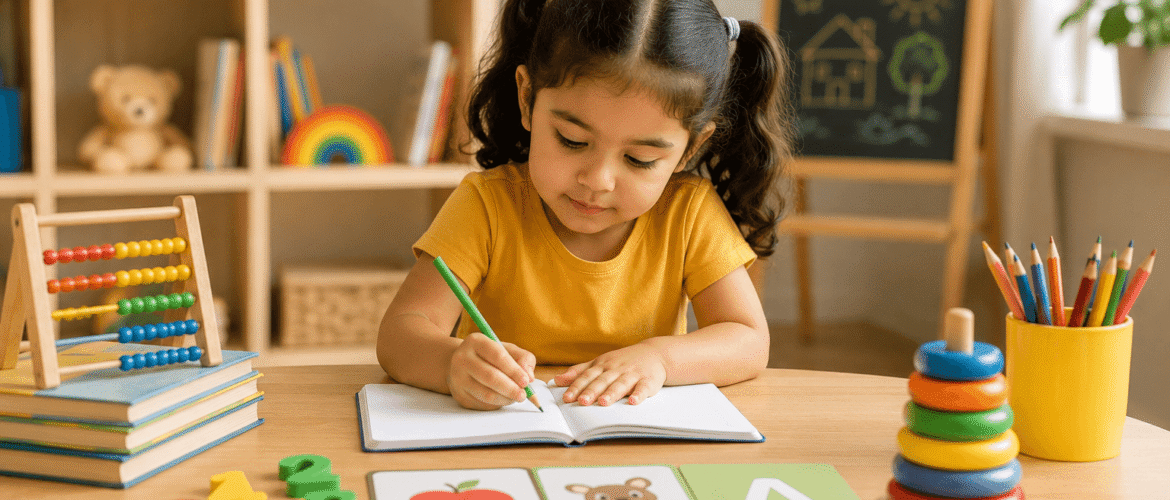
If you’re wondering what to teach a 5 year old at home, think less about “school syllabus” and more about playful daily learning. At this age, children learn best through stories, songs, movement, conversation, pretend play, and hands-on activities. A simple home routine can support early childhood education without making your child feel pressured.
Below are practical, India-friendly ideas you can try using everyday items already available at home.
1. Teach Basic Reading With Stories, Sounds, and Picture Books
Reading readiness is one of the most useful skills to build at age five. You do not need expensive workbooks. Start with sounds, picture recognition, and simple words.
Activities to try
- Read aloud for 10 minutes daily Choose short storybooks, Panchatantra tales, moral stories, or picture books in English, Hindi, or your regional language.
- Play “sound hunt” Say a sound like “b” and ask your child to find things at home that start with that sound: bottle, bag, ball.
- Label household items Stick simple labels on objects like door, bed, cup, fan, book, and bag. Read them together every day.
- Make a family name chart Write the names of family members and help your child identify the first letter of each name.
Materials needed
- Picture books or storybooks
- Chart paper
- Crayons or sketch pens
- Sticky notes
- Old magazines for picture cutting
Safety note
Use child-safe scissors only if your child is cutting pictures. Always supervise when using glue, staplers, or small craft items.
Also Read: how to teach english speaking to kids
2. Build Number Sense With Everyday Counting
If you are thinking about what to teach a 5 year old, numbers should be taught through real-life examples instead of only worksheets. Counting spoons, fruits, toys, and coins helps children understand numbers better.
Activities to try
- Count daily objects Count rotis, plates, steps, pencils, bangles, buttons, or toy cars.
- Sort and group items Ask your child to sort dal, rajma, buttons, blocks, or bottle caps by colour, size, or type.
- Use rupee coins for pretend shopping Set up a small home shop with biscuits, fruits, or toys. Let your child “buy” items using play money or real coins under supervision.
- Practice number writing in fun ways Write numbers in sand, atta, rice, or on a slate. This feels more playful than a notebook.
Materials needed
- Coins or play money
- Bowls and spoons
- Pulses, buttons, blocks, or bottle caps
- Notebook, slate, or tray of rice
Safety note
Coins, pulses, and buttons can be choking hazards. Stay with your child throughout the activity and keep small items away from younger siblings.
3. Introduce Shapes, Colours, and Patterns Through Art
Art is a powerful part of early childhood education because it supports fine motor skills, creativity, observation, and problem-solving.
Activities to try
- Shape hunt at home Ask your child to find circles, squares, rectangles, and triangles around the house. For example, a plate is a circle and a window may be a rectangle.
- Make simple rangoli patterns Use flower petals, coloured paper, or blocks to create repeating patterns like red-blue-red-blue.
- Draw with themes Give prompts like “draw your favourite fruit,” “draw your school bag,” or “draw a rainy day.”
- Colour mixing experiment Mix basic colours using poster colours or watercolours and let your child observe what happens.
Materials needed
- Crayons, colour pencils, or washable paints
- Paper or old newspapers
- Flower petals or coloured paper
- Building blocks or bottle caps
Safety note
Choose non-toxic colours and washable paints. Cover the floor with newspaper and make sure your child does not put colours or craft materials in their mouth.
Also Read: skills a child need to excel
4. Use Educational Games to Make Learning Feel Like Play
The best educational games for a 5 year old are simple, active, and easy to repeat. They should help your child think, speak, count, move, and remember.
Games to try
- Memory tray game Place 5 to 7 objects on a tray. Let your child look at them for one minute. Cover the tray and ask what they remember.
- Simon Says Use instructions like “touch your nose,” “jump twice,” or “clap three times.” This improves listening and body coordination.
- Treasure hunt Hide simple objects and give clues such as “look under the chair” or “find something red.”
- Match the cards Make homemade cards with numbers, letters, animals, fruits, or shapes. Ask your child to match similar cards.
- I Spy Say, “I spy something green” or “I spy something that starts with m.” This builds vocabulary and observation skills.
Materials needed
- Household objects
- Homemade flashcards
- Toys
- Basket or tray
- Paper and crayons
Safety note
Avoid games that involve running on slippery floors or climbing furniture. Keep the play area open and clutter-free.
5. Strengthen Speaking and Listening Skills
At five, children should get many chances to talk, ask questions, describe things, and listen carefully. This is especially helpful in multilingual Indian homes where children may hear English, Hindi, and a regional language.
Activities to try
- Daily conversation time Ask open-ended questions like, “What made you happy today?” or “What would you like to cook in your pretend kitchen?”
- Picture talk Show a picture from a book or calendar and ask your child to describe what they see.
- Story retelling After reading a story, ask your child to tell it back in their own words.
- Rhyme and song time Sing nursery rhymes, counting songs, folk songs, or simple bhajans. Songs help children remember words and rhythm.
Materials needed
- Storybooks
- Family photos
- Picture cards
- Rhymes or songs
Safety note
Do not force perfect pronunciation. Correct gently by repeating the word naturally instead of making your child feel embarrassed.
Also Read: how to make learning fun for kids
6. Teach Practical Life Skills
Home is the best place to teach independence. Simple daily tasks build confidence, responsibility, and motor skills.
Activities to try
- Folding small clothes Start with handkerchiefs, socks, or small towels.
- Arranging school items Ask your child to keep pencils, books, and crayons in the right place.
- Watering plants Give a small mug and teach them how much water a plant needs.
- Helping at mealtime Let them place spoons, napkins, or plates on the table.
- Learning personal hygiene Practice handwashing, brushing teeth, combing hair, and covering the mouth while coughing.
Materials needed
- Child-sized mug
- Small towel
- Storage baskets
- Toothbrush and soap
- Simple chore chart
Safety note
Keep children away from knives, hot utensils, gas stoves, electrical switches, cleaning liquids, and heavy objects.
7. Explore Nature and Science With Simple Experiments
You can introduce science without using big words. At this age, science means noticing, asking, touching, smelling, comparing, and wondering.
Activities to try
- Sink or float experiment Use a bowl of water and safe items like a leaf, spoon, coin, sponge, and plastic lid. Ask your child to guess what will sink or float.
- Grow seeds in cotton Place rajma, chana, or moong seeds on wet cotton and observe them daily.
- Weather chart Mark sunny, cloudy, rainy, or windy days on a calendar.
- Nature walk Visit your building garden, terrace plants, or a nearby park. Look for leaves, flowers, birds, ants, and clouds.
Materials needed
- Bowl of water
- Safe household items
- Seeds and cotton
- Calendar
- Crayons
Safety note
Supervise all water activities. During outdoor walks, watch for insects, sharp objects, traffic, and unsafe plants.
8. Support Fine Motor Skills Before Heavy Writing Practice
Many parents worry about handwriting, but before long writing tasks, children need finger strength and hand control.
Activities to try
- Play with clay or dough Rolling, pinching, and shaping dough strengthens fingers.
- Thread big beads Use large beads or pasta with thick thread.
- Tear and paste paper Let your child tear coloured paper and paste it into a simple picture.
- Trace lines and curves Practice standing lines, sleeping lines, circles, waves, and zigzags before letters.
Materials needed
- Clay or homemade dough
- Large beads or pasta
- Thick thread
- Paper and glue
- Crayons or pencils
Safety note
Avoid tiny beads if your child still puts objects in their mouth. Use non-toxic clay and supervise closely.
9. Teach Social and Emotional Skills
A 5 year old also needs to learn how to manage feelings, share, wait, and express needs politely. These skills are just as important as reading and counting.
Activities to try
- Feelings chart Draw faces for happy, sad, angry, scared, and excited. Ask your child to point to how they feel.
- Role play Practice situations like greeting guests, asking for help, saying sorry, or sharing toys.
- Calm-down corner Create a small space with cushions, books, and soft toys where your child can relax.
- Turn-taking games Play simple board games or ball games where your child waits for their turn.
Materials needed
- Paper and crayons
- Soft toys
- Cushions
- Simple board games
- Storybooks about emotions
Safety note
Avoid labelling your child as “naughty” or “bad.” Focus on the behaviour and guide them with calm words.
10. Follow a Simple Home Learning Routine
A routine helps children feel secure, but it should not feel like a full school timetable. Keep learning sessions short and playful.
Sample daily routine
- 10 minutes: Story reading
- 10 minutes: Counting or number game
- 15 minutes: Art, craft, or writing readiness
- 15 minutes: Free play or pretend play
- 10 minutes: Outdoor play, yoga, dance, or movement
- 5 minutes: Clean-up and reflection
You can change the order based on your child’s mood. Some days will be smooth, and some days your child may not be interested. That is normal.
Give Your Child a Head Start with Phonics
Are you a parent living in Ghaziabad? Enroll your child in Foxbrain’s Phonics Classes to improve reading fluency, pronunciation, spelling, and writing skills in a fun and supportive environment. Start their learning journey with a FREE demo class today!
Final Tips for Teaching a 5 Year Old at Home
When deciding what to teach a 5 year old at home, focus on balanced growth. Include reading, numbers, art, movement, language, life skills, and emotional learning. Keep activities short, repeat them often, and celebrate small progress.
Most importantly, do not compare your child with others. A loving, playful home environment is one of the strongest foundations for lifelong learning.