
Blog
How to teach math to 1st graders

How to teach math to 1st graders
If you’re wondering how to teach math to 1st graders, the best place to start is with this simple idea: first graders learn math best when they can see it, touch it, talk about it, and connect it to everyday life. At this age, math should feel active and meaningful—not like memorizing rules too early.
First grade is a big year for building number sense, addition and subtraction strategies, place value, measurement, shapes, and early problem-solving confidence. Whether you’re teaching in a classroom, supporting homework at home, or planning small-group intervention, the goal is the same: help children understand what numbers mean before asking them to move quickly or work abstractly.
What 1st Graders Need to Learn in Math
Most 1st grade math programs in the United States focus on a few major skill areas. The exact curriculum may vary by school or state, but the core concepts are usually similar.
First graders typically work on:
- Counting forward and backward
- Reading and writing numbers
- Understanding numbers up to 100 or beyond
- Comparing numbers using greater than, less than, and equal to language
- Adding and subtracting within 20
- Solving word problems
- Understanding place value with tens and ones
- Measuring and comparing lengths
- Telling time to the hour and half hour
- Identifying and describing 2D and 3D shapes
- Organizing and interpreting simple data
The most important foundation is number sense. A child with strong number sense understands that numbers represent quantities, can compare amounts, can break numbers apart, and can use flexible strategies instead of relying only on counting one by one.
Start With Concrete Objects Before Worksheets
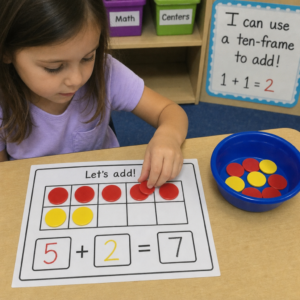
Many 1st graders are not ready to understand math only through symbols like 8 + 5 = 13. They need concrete experiences first. This means using real objects to model math ideas.
Helpful hands-on materials include:
- Counters
- Linking cubes
- Ten-frames
- Number lines
- Base-ten blocks
- Buttons, coins, beads, or cereal pieces
- Dice and dominoes
- Craft sticks bundled into groups of ten
For example, before asking a child to solve 6 + 4, give them 6 counters and 4 more counters. Ask:
- “How many do you have first?”
- “How many more did we add?”
- “How many are there altogether?”
- “Can you show it another way?”
This helps students understand that addition means joining groups. Once they understand the action, the written equation becomes much more meaningful.
Use the CPA Approach: Concrete, Pictorial, Abstract
A strong way to teach 1st grade math is to move through three stages: concrete, pictorial, and abstract.
Concrete means students use physical objects. For example, they use cubes to show 9 plus 3.
Pictorial means students draw the math. They might draw circles, dots, tally marks, number bonds, or jumps on a number line.
Abstract means students use numbers and symbols. They write 9 + 3 = 12 after they understand what the equation represents.
This progression prevents students from memorizing procedures without understanding. If a child is confused at the abstract stage, move back to pictures or objects. That is not going backward—it is good teaching.
Build Daily Counting Routines
Counting is not just a preschool skill. In 1st grade, students need many opportunities to count in different ways.
Practice counting:
- Forward by ones
- Backward from 20, 50, or 100
- By tens
- By fives
- By twos
- Starting from numbers other than 1
- Across decade numbers, such as 28, 29, 30, 31
Try short routines like:
- “Start at 37 and count to 45.”
- “Count backward from 20 to 10.”
- “Count by tens starting at 10.”
- “What number comes before 60?”
- “What number comes after 79?”
Counting from a number other than 1 is especially important because it supports addition. For example, a child solving 8 + 3 can start at 8 and count on: 9, 10, 11.
Teach Addition as Flexible Thinking
Addition in 1st grade should be taught with several strategies, not just one method. Students need to understand that there are many ways to solve a problem.
Useful addition strategies include:
- Counting all
- Counting on
- Using doubles
- Using near doubles
- Making ten
- Decomposing numbers
- Using a number line
- Using ten-frames
For 7 + 6, a child might solve it by thinking:
- “I know 6 + 6 = 12, so 7 + 6 is one more. That’s 13.”
- “I can take 3 from the 6 and give it to 7 to make 10. Then 10 + 3 = 13.”
- “I can count on from 7: 8, 9, 10, 11, 12, 13.”
When children share different strategies, they learn that math is about reasoning, not just getting an answer quickly.
Teach Subtraction With Real Meaning
Subtraction can mean different things, so students need to experience it in multiple contexts.
Subtraction may mean:
- Taking away: “You had 10 grapes and ate 3.”
- Finding the difference: “Sam has 8 stickers and Mia has 5. How many more does Sam have?”
- Finding a missing part: “There are 9 animals. 4 are dogs and the rest are cats.”
Use stories, objects, and drawings to make subtraction clear.
For example, for 12 – 5, you can ask students to:
- Build 12 with counters.
- Remove 5 counters.
- Count what remains.
- Write the equation.
- Explain the subtraction story in words.
Students should also learn that addition and subtraction are related. If they know 8 + 4 = 12, they can use that fact to solve 12 – 8 = 4 and 12 – 4 = 8.
Make Place Value Visual
Place value is one of the most important 1st grade math concepts. Students need to understand that a two-digit number is made of tens and ones.
For example, 47 means:
- 4 tens
- 7 ones
- 40 and 7
Use base-ten blocks, craft sticks, or drawings to show this. Bundle 10 sticks together with a rubber band so students can physically see that 10 ones become 1 ten.
Try these place value activities:
- Build a number with tens and ones.
- Draw quick tens and ones.
- Compare two numbers using tens first.
- Decompose numbers in multiple ways.
- Ask, “How many tens are in 63?”
- Ask, “What is 10 more than 42?”
A common mistake is rushing students into written place value before they understand the quantity. Keep returning to models until students can explain numbers clearly.
Use Word Problems Every Week
Word problems help students apply math to real situations. They also build reading comprehension, reasoning, and mathematical communication.
Start with simple, familiar situations:
- “There are 6 birds in a tree. 3 more birds land. How many birds are there now?”
- “Lena has 12 crayons. She gives 4 to a friend. How many crayons does she have left?”
- “There are 9 apples. Some are red and 5 are green. How many are red?”
Teach students to slow down and think through the story.
A simple routine is:
- Read the problem.
- Retell it in your own words.
- Ask, “What is happening?”
- Choose a strategy.
- Draw or model the problem.
- Write an equation.
- Answer in a complete sentence.
Avoid teaching students to rely only on keywords like “more means add” or “left means subtract.” Keywords can be misleading. Instead, focus on understanding the situation.
How to Teach Mental Math to 1st Graders
Parents and teachers often ask how to teach mental math to 1st graders without turning math into speed drills. The key is to build mental math through understanding, patterns, and repeated practice—not pressure.
Mental math for 1st graders should focus on small, flexible strategies such as:
- Counting on from the larger number
- Recognizing doubles
- Making ten
- Breaking numbers apart
- Using known facts to solve unknown facts
- Adding or subtracting 10 mentally
For example, to solve 9 + 4, a child can think:
- “9 needs 1 more to make 10.”
- “I can break 4 into 1 and 3.”
- “9 + 1 = 10.”
- “10 + 3 = 13.”
That is mental math, but it is also deep number sense.
Mental Math Activities That Work
Try these short activities for 5 to 10 minutes at a time:
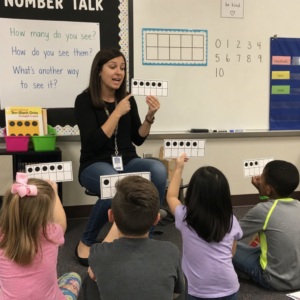
Quick images: Show a ten-frame or dot pattern for 2 seconds, then hide it. Ask, “How many did you see? How did you know?”
Number talks: Present one problem, such as 8 + 5, and invite students to explain different ways to solve it mentally.
Make ten games: Give students numbers and ask what each number needs to make 10. For example, “What does 6 need to make 10?”
Doubles practice: Use facts like 4 + 4, 5 + 5, and 6 + 6, then connect them to near doubles like 5 + 6.
Ten more, ten less: Ask questions like, “What is 10 more than 34?” or “What is 10 less than 58?” Use a hundred chart at first, then gradually remove it.
The goal is not to make children answer instantly. The goal is to help them think efficiently and explain their reasoning.
Make Math Part of Everyday Life at Home
Home practice does not need to look like schoolwork. In fact, short real-life math moments are often more effective than long worksheets.
Families can practice 1st grade math by asking questions during daily routines:
- “We have 4 forks on the table. How many more do we need for 6 people?”
- “You have 7 crackers. If I give you 3 more, how many will you have?”
- “There are 10 toy cars. 6 are blue. How many are not blue?”
- “Can you count the steps from the door to the kitchen?”
- “Which cup is taller?”
- “What shape is this cereal box?”
Board games, card games, dice games, and cooking are also excellent for math practice. The best home math activities feel playful and conversational.
Keep Lessons Short, Active, and Focused
First graders usually learn best in short chunks. A strong math lesson might include:
- A quick warm-up
- A short teacher model
- Guided practice with objects or drawings
- Partner or independent practice
- A math talk or reflection
For classroom instruction, consider rotating between whole-group mini-lessons, small-group practice, math centers, and individual check-ins. For home instruction, 10 to 15 focused minutes may be enough, especially when followed by a game or hands-on activity.
Movement can also help. Students can hop on a number line, build numbers with cubes, sort shapes around the room, or act out word problems.
Use Games to Build Fluency
Fluency means students can solve accurately, efficiently, and flexibly. It does not mean rushing. Games are one of the best ways to build fluency without creating math anxiety.
Try these simple games:
Roll and add: Roll two dice, add the numbers, and explain the strategy.
Ten-frame fill: Use counters to fill a ten-frame and ask how many more are needed to make 10.
War with cards: Each player flips a card. The larger number wins, or players add two cards and compare sums.
Number line jumps: Give a starting number and a number to add or subtract. Students show jumps on a number line.
Missing number match: Write equations with missing numbers, such as 7 + __ = 10, and match them to answer cards.
Games provide repetition, but they also keep students engaged.
Support Students Who Struggle
If a 1st grader struggles with math, slow down and return to concrete models. Many students need more time with objects, drawings, and oral explanations before they are ready for written work.
Helpful supports include:
- Smaller numbers
- More visual models
- Repeated routines
- One strategy at a time
- Frequent review
- Math vocabulary practice
- Encouragement to explain thinking
Watch for signs that a student may need extra support:
- Difficulty counting accurately
- Trouble recognizing quantities without counting every object
- Confusing teen numbers
- Reversing digits often
- Struggling to compare numbers
- Not understanding addition or subtraction stories
When a child makes an error, ask questions instead of immediately correcting:
- “Can you show me how you got that?”
- “Does your answer make sense?”
- “Can we build it with cubes?”
- “Is there another way to solve it?”
This keeps the child thinking and reduces frustration.
Challenge Students Who Are Ready for More
Some 1st graders quickly grasp the basics and need enrichment. Challenge does not always mean giving bigger numbers. It can mean asking for deeper reasoning.
Try prompts like:
- “Can you solve it a different way?”
- “Can you write a word problem for this equation?”
- “How do you know your answer is correct?”
- “Can you find all the ways to make 12?”
- “Can you explain your strategy to a classmate?”
You can also introduce open-ended problems, such as:
- “The answer is 15. What could the addition problem be?”
- “I have 3 coins. What might they be?”
- “Create a shape using only triangles and rectangles.”
These tasks encourage creativity, reasoning, and communication.
Build Math Vocabulary Naturally
First graders need to understand math words, not just numbers. Use vocabulary during lessons, games, and conversations.
Important words include:
- Add
- Subtract
- Equal
- Sum
- Difference
- More
- Fewer
- Compare
- Tens
- Ones
- Digit
- Number line
- Equation
- Strategy
Ask students to use math words when explaining their thinking. For example, instead of saying, “I got 14,” they might say, “I added 8 and 6 by making a ten, and the sum is 14.”
Do not expect perfect language right away. Model it often and celebrate attempts.
Check Understanding Often
Assessment in 1st grade does not have to be formal. You can learn a lot by listening to students explain their thinking.
Use quick checks like:
- Ask students to show a number with counters.
- Have them draw a word problem.
- Ask, “Which strategy did you use?”
- Give one exit question at the end of a lesson.
- Watch how they play a math game.
- Ask them to compare two numbers and explain why.
The best assessments show not only whether the answer is correct, but how the child is thinking.
Common Mistakes to Avoid
When teaching 1st grade math, try to avoid these common mistakes:
- Moving to symbols before students understand the concept
- Relying too heavily on worksheets
- Treating speed as the main goal
- Teaching only one strategy
- Skipping place value models
- Correcting errors without asking students to explain
- Using math facts as isolated memorization too early
- Making word problems about keywords instead of meaning
A balanced approach includes hands-on practice, visual models, mental strategies, discussion, games, and written work.
A Simple Weekly Practice Plan
Here is a practical rhythm that can work in a classroom or at home:
Monday: Introduce a concept with objects and discussion.
Tuesday: Practice with drawings, ten-frames, number lines, or models.
Wednesday: Apply the concept in word problems.
Thursday: Play a math game that reinforces the skill.
Friday: Review, explain strategies, and do a quick check for understanding.
This kind of structure gives students repetition without making every day feel the same.
Final Tips for Teaching 1st Grade Math Well
The most effective way to teach 1st grade math is to make numbers meaningful. Start with concrete experiences, use visual models, encourage students to talk about their thinking, and connect math to real life.
Remember these guiding principles:
- Understanding comes before speed.
- Hands-on learning matters.
- Mistakes are part of learning.
- Mental math should be strategy-based.
- Word problems should be about sense-making.
- Repetition works best when it feels varied and playful.
When children see math as something they can explore, explain, and use, they become more confident problem-solvers. That confidence is one of the most valuable skills they can carry into the rest of elementary school.