
Blog
Exploring Various Types of Abacus Designs
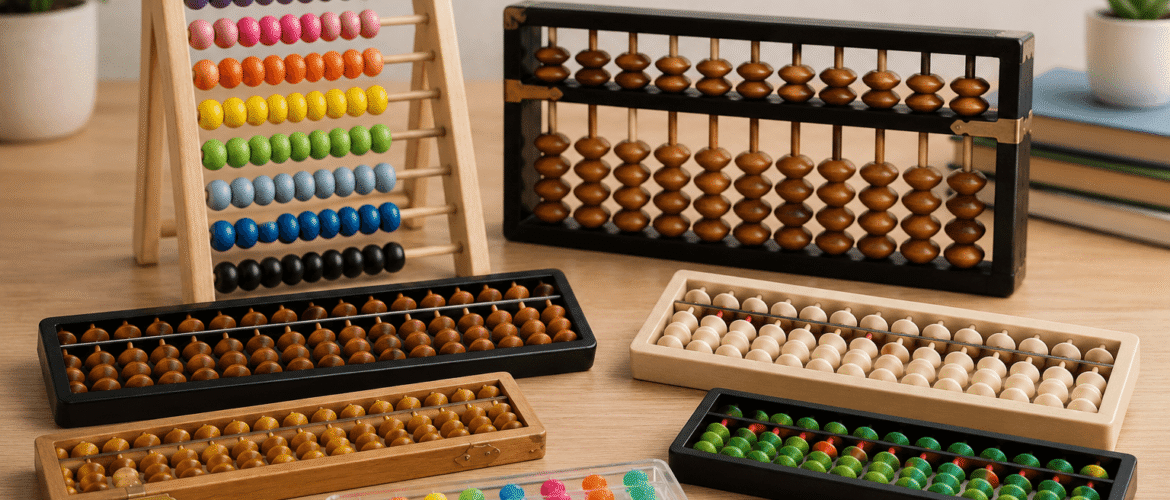
Exploring Various Types of Abacus Designs
The abacus is a fascinating tool with a rich history. It has been used for thousands of years.
This ancient device has helped countless people perform calculations. Its simplicity and effectiveness are remarkable.
Different cultures have developed unique abacus designs. Each design reflects the needs and influences of its time.
From the Chinese Suanpan to the Japanese Soroban, each type has distinct features. These variations offer insight into cultural exchanges.
The abacus is more than just a counting tool. It is a symbol of human ingenuity and problem-solving.
Today, the abacus remains a valuable educational tool. It aids in teaching arithmetic and mental calculation skills.
Understanding the different types of abacus can enhance our appreciation of mathematics. It also highlights the evolution of mathematical tools.
The Origins and Evolution of the Abacus
The abacus is one of the earliest tools for calculations. Its roots trace back over 4,000 years.
Early abaci were likely simple counting boards. They evolved as human civilization and trade grew.
The abacus has been found in various ancient cultures. Each had its own adaptation based on regional needs.
Initially, abacuses involved moving counters or beads on a board. These facilitated arithmetic operations.
Through time, the abacus underwent significant transformations. These changes mirrored advancements in mathematical understanding.
As trade routes expanded, different cultures exchanged their abacus designs. This led to the blending of ideas and techniques.
The evolution of the abacus can be grouped into several key stages:
- Early counting boards with pebbles.
- Introduction of rods and beads.
- Portable versions like the Roman abacus.
- Regional variations such as the Suanpan, Soroban, and Schoty.
These stages highlight the diversity in design and usage across the globe.
The abacus has outlasted many other calculating devices. Its endurance is a testament to its utility and adaptability.
Today, the abacus still teaches fundamental math concepts, showcasing its timeless relevance.
Why Are There Different Types of Abacus?
Different types of abacus exist due to varied cultural needs. Each civilization tailored the abacus to suit its mathematical challenges.
Geography influenced the materials and construction of abacuses. Regions with abundant wood used it extensively in their abacus designs.
Trade routes enabled the sharing of mathematical knowledge. As a result, abacus designs became diverse and multifunctional.
The mathematical tasks each society faced shaped abacus designs. These tasks included trade calculations, taxation, and geometry.
Key factors that led to different abacus types include:
- Cultural interaction and exchange of knowledge.
- Local trade and economic demands.
- Adaptation to available resources.
- Evolving mathematical theories and needs.
Each abacus variant reflects its culture’s unique history and mathematical evolution.

by Alexandr Popadin (https://unsplash.com/@irrabagon)
Ancient Abacus Types: Early Counting Tools
The abacus is one of the earliest counting tools. Its usage can be traced back to ancient civilizations.
Initially, simple devices met the need for calculation. Different cultures innovated these early tools based on their requirements.
Over time, several designs emerged, each offering unique features. From dust markings to intricate counters, the variety reflects diverse needs.
Some ancient types include dust abacuses and pebble counters. They showcase the ingenuity of ancient civilizations in problem-solving.
Below are key ancient abacus designs:
- The Dust Abacus: Used by merchants for quick calculations.
- Sumerian and Mesopotamian Abacus: Early versions featured simple layouts.
- Pebble and Counter Abacus: Portable for merchants to carry.
- The Salamis Tablet: A sophisticated counting tool for advanced calculations.
These early tools laid the foundation for modern numerical systems. They highlight the universal quest for efficient calculation methods.
Each design reflects specific cultural influences. They illustrate the evolution of mathematical practices across regions.
The Dust Abacus
The Dust Abacus was one of the earliest abacus designs. Traders used it for market calculations.
It consisted of a surface covered with sand or dust. Users drew lines or symbols to represent numbers.
The method allowed quick, erasable computations. Simple yet effective, it was common in ancient trading societies.

by Oleksii Piekhov (https://unsplash.com/@opiekhov)
The Sumerian and Mesopotamian Abacus
Sumerians and Mesopotamians developed early abacus forms. These tools were crucial for managing trade and tax calculations.
Crafted with basic lines and grooves, they were straightforward. This design’s simplicity supported essential arithmetic operations.
The Pebble and Counter Abacus
The Pebble and Counter Abacus was versatile. Ancient merchants found it ideal for trade due to its portability.
This tool used pebbles or small counters. They represented numbers on a marked surface, allowing calculations through simple movements.
Its adaptability made it a prevalent choice for traveling traders.
The Salamis Tablet
The Salamis Tablet is a Greek innovation in counting. Discovered on the island of Salamis, it dates back to 300 B.C.
It featured grooves for beads or counters. This design allowed for complex arithmetic, demonstrating advanced Greek mathematical skills.
The Roman Abacus: Design and Usage
The Roman abacus was a sophisticated and portable counting device. Used extensively across the Roman Empire, it facilitated complex calculations. Its design included a series of grooves or slots.
Each groove held a series of beads. These beads could be moved to perform arithmetic operations. The tool was compact, making it convenient for officials and traders.
The Roman abacus was more advanced than earlier versions. It introduced a structured layout, which aligned with the Roman numeral system. This alignment allowed for efficient addition, subtraction, and even basic division.
Key features of the Roman abacus included:
- Grooved surface: Enabled easy bead movement.
- Portable size: Suited for travel and official work.
- Structured layout: Corresponded with Roman numerals for accurate calculations.
The Roman design marked an evolution in the functionality of abacus tools. It highlighted the need for practical, portable solutions in ancient commerce.

by Enric Moreu (https://unsplash.com/@enric_moreu)
The Chinese Abacus (Suanpan)
The Chinese abacus, known as the Suanpan, is a remarkable tool in the history of mathematics. This ancient device remains popular due to its efficient design and versatility.
A typical Suanpan features multiple rods with beads arranged in two decks. The upper deck has two beads per rod, while the lower deck contains five. This structure facilitates calculations based on the decimal system.
Chinese merchants and mathematicians extensively used the Suanpan. Its design enables swift arithmetic operations such as addition and subtraction. It also supports more complex calculations, including multiplication and division.
The Suanpan’s design has influenced other abacus types worldwide. Its dual-bead system allows users to perform calculations quickly and accurately. It is a testament to ancient innovation and cultural exchange.
Notably, the Suanpan is still used in educational settings. It aids learners in grasping numerical concepts and enhances mental calculation skills. It is an enduring symbol of China’s mathematical heritage.
Key features of the Suanpan include:
- Two-bead upper deck: For efficiency.
- Five-bead lower deck: For versatility.
- Decimal system compatibility: Facilitates complex math.
The Japanese Abacus (Soroban)
The Japanese abacus, known as the Soroban, is a refined version of earlier abacus models. Its design simplifies calculations and promotes faster processing.
A typical Soroban features a smaller frame than the Chinese Suanpan. It has one bead on the upper deck and four on the lower deck. This configuration caters specifically to the decimal system.
The Soroban gained popularity in Japan during the 16th century. It was valued for its portability and ease of use in everyday transactions and teaching.
The design modifications reflect Japan’s emphasis on simplicity and efficiency. The Soroban is praised for its speed in performing arithmetic operations like addition and subtraction.
Today, the Soroban remains an essential tool in education. It helps improve students’ numerical skills and fosters mental agility. Competitions and classes worldwide still promote its use.
Distinctive features of the Soroban include:
- One-bead upper deck: Ensures quick calculations.
- Four-bead lower deck: Supports a range of operations.
- Compact frame: Increases portability and user-friendliness.
The Russian Abacus (Schoty)
The Russian abacus, or Schoty, is a horizontal abacus design. Its unique structure reflects Russian mathematical traditions.
Unlike the vertical layouts of other abacuses, the Schoty is laid flat. It consists of rows with ten beads each on slender rods. This setup aligns with a base-ten counting system.
The Schoty became widespread in Russia during the 17th century. It was primarily used by shopkeepers and merchants for quick computations. This abacus type remains popular due to its simplicity and effectiveness.
One key feature is its operation from left to right. This distinguishes it from other abacuses and mirrors natural reading direction. It requires users to push beads back and forth, fostering tactile learning experiences.
Presently, the Schoty still plays a significant role in some Russian schools. Teachers use it to aid students in grasping basic arithmetic concepts.
Notable aspects of the Schoty include:
- Ten beads per row: Simplifies calculations.
- Horizontal orientation: Matches the natural reading flow.
- Ease of use: Beneficial for quick mental math exercises.
The Indian Abacus and Other Regional Variations
The Indian abacus shares a lineage with the ancient Chinese design. Both feature a double-deck structure but show regional adaptations.
Indian cultures have used the abacus since ancient times for trade and education. It served as an essential tool for merchants dealing with complex calculations. Over time, unique characteristics emerged, customizing the device for local needs.
This type typically incorporates a base of ten in its layout. Such a structure accommodates the arithmetic operations essential in the Indian numeric system. Historically, Indian abacuses have played a crucial role in teaching mathematics.
Besides India, various regions have developed their own abacus styles. Each has distinct features shaped by local customs and requirements.
Examples of regional variations include:
- Middle Eastern Abacuses: Often use materials unique to the region.
- African Abacuses: Reflect indigenous counting methods.
- European Variations: Adapted for commercial use in medieval markets.
Modern Abacus Types and Adaptations
Today’s abacus designs continue to evolve, catering to diverse educational needs. Modern variants are often digital or use innovative materials.
Digital abacuses provide interactive learning experiences. They are equipped with software to simulate bead movements. These adaptations make learning dynamic and engaging.
Other modern designs serve specialized purposes. They can tailor arithmetic tools to individuals with specific requirements.
For instance, adaptations address the needs of the visually impaired. These designs include tactile features enhancing accessibility.
Innovative abacus models also support early math education with colorful and appealing designs. These teaching aids foster numerical skills among young learners.
Modern abacus examples include:
- Digital Abacus Apps
- Child-Friendly Abacuses
- Functional Abacuses for Special Needs
The Cranmer Abacus for the Visually Impaired
The Cranmer Abacus is specially designed for visually impaired users. Its tactile features make calculations accessible through touch.
This abacus eliminates the need for visual cues. Beads are designed to stay in place, aiding precision.
By facilitating tactile number manipulation, it supports those who rely on senses other than sight. These features make complex arithmetic operations achievable.
The Cranmer Abacus remains a vital tool for education and independence, enhancing the learning experience for users.
The Danish Abacus and Rekenrek
The Danish Abacus, or Rekenrek, simplifies early math concepts for children. It is a significant educational tool in Nordic countries.
This design typically features two rows with ten beads each. It presents arithmetic visually, facilitating understanding of basic calculations.
The Rekenrek’s unique layout is ideal for teaching addition and subtraction. It helps learners visualize processes like grouping and counting.
By providing visual arithmetic lessons, it aids young students in grasping foundational math concepts. This tool proves effective in early education settings.

by luis arias (https://unsplash.com/@luis_arias)
Comparing Abacus Types: Key Differences and Similarities
Abacus types vary in structure and function, reflecting cultural and historical influences. Despite these differences, all abacuses serve the same fundamental purpose: aiding in calculations.
The Chinese Suanpan and the Japanese Soroban, for example, differ in bead counts but share a similar vertical frame. This layout allows for quick operations, emphasizing efficiency.
In contrast, the Russian Schoty, used horizontally, has a unique layout. Its design includes rows of beads conducive to calculations based on the decimal system.
While structural elements may differ, bead manipulation remains a common technique across all types. This consistency underscores their universal role as counting tools.
Key differences among abacus types include:
- Bead Count
- Frame Orientation
- Cultural Influences
- Calculation Methods
How Many Different Types of Abacus Are There?
The abacus has diversified into numerous types, each adapted to distinct historical and cultural needs. While the most recognized variants include the Chinese, Japanese, Russian, Indian, and Roman abacuses, several lesser-known types exist. These variations demonstrate its adaptability over time.
Understanding the types helps appreciate the tool’s complexity and historical significance. Each abacus reflects the unique computational demands of its era and region. This diversity illustrates the ingenuity behind each design.
In summarizing the different types of abacus, key examples include:
- Chinese Suanpan
- Japanese Soroban
- Russian Schoty
- Roman Abacus
- Indian Variants
What Are the Different Types of Abacus Used For?
Abacuses serve a variety of educational and practical purposes. Primarily, they are used for performing arithmetic calculations, such as addition and subtraction. Different types also have specific applications.
Cultural variations have led to unique uses. For example, the Chinese Suanpan can perform complex operations, including multiplication and division. In contrast, the Japanese Soroban aids in rapid mental arithmetic.
Modern adaptations of the abacus find use in education, especially for young children and the visually impaired. These designs help develop numerical understanding and improve cognitive skills.
The following list highlights the typical uses of abacus types:
- Basic arithmetic computations
- Advanced mathematical operations
- Teaching numerical concepts to children
- Aiding visually impaired individuals
Educational Benefits of Using Different Abacus Types
Learning with an abacus provides significant educational benefits. This ancient tool enhances mathematical skills and fosters logical thinking. It engages both sides of the brain, offering a hands-on learning experience.
Different types of abacuses are beneficial in various educational contexts. Using a Chinese or Japanese abacus, for instance, can enhance rapid calculation skills. These devices develop speed and accuracy in mental math.
For young children, the colorful design of many abacuses makes learning fun. It encourages engagement and helps in visualizing numbers. This visual aspect aids in understanding place values and arithmetic operations.
The tactile nature of an abacus boosts memory and improves cognitive development. It provides a multi-sensory learning approach combining sight, touch, and sound.
The following highlights the educational benefits of abacus use:
- Enhances mental arithmetic and calculation speed
- Reinforces understanding of place value and number concepts
- Improves memory and cognitive skills
- Provides a multi-sensory learning experience
The Abacus in Modern Education and Technology
Despite modern technology, the abacus remains relevant in education. It complements digital tools, bridging traditional and contemporary learning methods. This integration enhances overall mathematical comprehension.
In classrooms, the abacus serves as a tactile learning aid. It supports students in grasping foundational math concepts. Teachers use it to teach arithmetic operations in an engaging way.
Technological advancements have led to digital abacuses. These virtual tools mimic traditional abacus functions. They offer interactive experiences, enhancing accessibility and learning engagement.
The interplay between the abacus and technology encourages innovative teaching strategies. This synergy enriches learning environments, making math more accessible and enjoyable.
Key contributions of the abacus in modern education include:
- Complementing digital learning tools
- Reinforcing foundational math concepts
- Enhancing interactive and accessible learning experiences
- Supporting innovative teaching methods
Cultural Significance and Legacy of the Abacus
The abacus transcends its role as a mere calculation tool. It embodies cultural heritage, reflecting diverse mathematical approaches across civilizations. Each design tells a story of its culture’s ingenuity and needs.
In ancient times, the abacus facilitated trade and commerce. Its use spread along trade routes, influencing various cultures. The sharing of abacus designs highlighted knowledge exchange between regions.
Today, the abacus symbolizes historical continuity in education. Many cultures cherish it as a tradition passed through generations. This deep-rooted significance adds to its enduring presence worldwide.
Key aspects of the abacus’s cultural legacy include:
- Reflection of diverse cultural traditions
- Facilitation of historical trade and communication
- Symbol of educational heritage
- Representation of ancient technological ingenuity
Frequently Asked Questions About Abacus Types
Are there different types of abacus?
Indeed, there are various abacus types. Each type serves unique cultural and practical purposes.
What are the different types of abacus?
Examples include the Chinese Suanpan, Japanese Soroban, Russian Schoty, and Roman abacus. Each has distinct features.
How many different types of abacus are there?
Numerous, spanning ancient and modern designs, each with specific uses and adaptations.
Why are there different types of abacus?
Cultural needs and mathematical evolution sparked different designs. These reflect local counting methods and trade requirements.
Are modern abacus designs different?
Yes, modern types like the Cranmer abacus cater to specific needs, such as aiding visually impaired individuals.
Key Abacus Types Include:
- Chinese Suanpan
- Japanese Soroban
- Russian Schoty
- Roman Abacus
- Modern adaptations
Each type offers insight into historical and cultural contexts.
Conclusion: The Enduring Value of Abacus Designs
The abacus remains a timeless testament to human innovation. Its simplicity and effectiveness bridge ancient techniques and modern educational applications. Across ages and cultures, it has consistently served diverse mathematical needs.
Despite technological advances, the abacus continues to be cherished. Its tactile nature enhances learning, especially in developing cognitive skills and number sense. Each unique design speaks to the ingenuity and adaptability of those who crafted it.
Embracing the abacus in today’s world enriches our understanding of mathematics and history. This enduring tool reflects a cultural legacy and the foundational aspects of human computation.